September 15, 2026 · Uncategorized
Radiant Cut Lab Grown Diamond Ring Buying Guide
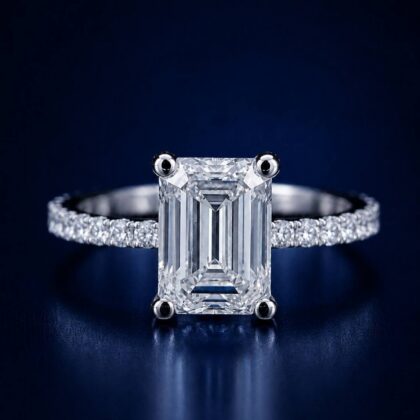
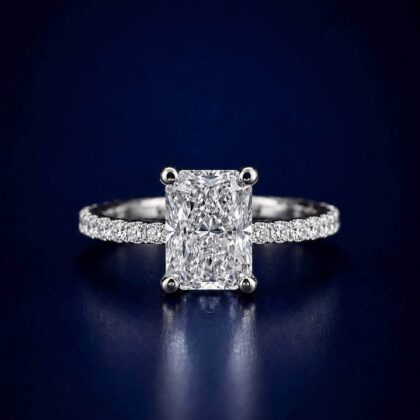
You're in Las Vegas, the proposal is planned for this afternoon, and the chapel has a narrow opening before dinner. You need a ring that's physically in town, certified, attractive under low light, and ready to leave with you. That's where a radiant cut lab-grown diamond ring earns serious consideration. Its rectangular or square outline gives strong finger coverage, while its brilliant-style faceting produces the sparkle most couples want from a proposal ring.
For Las Vegas shoppers, the decision isn't just about choosing a shape. You need to verify the IGI report, judge the proportions, compare the stone in person, and confirm that the setting and size work today. The radiant cut is especially practical for a same-day proposal because it appears in many ready-to-view inventories and fits familiar solitaire and four-prong settings.
Table of Contents
- A Same-Day Ring in Las Vegas Starts with the Right Cut
- How the Radiant Cut Is Built and Why It Sparkles
- Radiant Cut Against Oval and Emerald at the Same Carat
- Reading the IGI Report on a Lab Grown Radiant
- Carat, Clarity, Color, and Proportions That Matter
- How an In-Stock Las Vegas Shop Compares
- The Text-Booked Visit from Budget Message to Ring in Hand
- Bringing It Together Before You Buy
A Same-Day Ring in Las Vegas Starts with the Right Cut
A couple walks into a Las Vegas wedding chapel on a Tuesday afternoon. They arrived around noon, the ceremony is planned for later, and the proposal still needs a ring. By four, the stone must look convincing across a dim aisle, sit securely in a setting, and be ready to take away without waiting for a special order.
In that situation, I'd start with a radiant cut. It has a rectangular or square outline with trimmed corners, so it looks distinctive without demanding an unusual mounting. A standard four-prong or solitaire setting can often accommodate the shape, which matters when the jeweler is working from an in-stock case rather than building a ring from scratch.
The radiant was invented in 1977 by New York diamond cutter Henry Grossbard, who wanted the elegant outline of an emerald cut with the brilliance of a round brilliant. The design was patented and became more broadly available after the patent expired in the late 1990s, helping increase production and reduce costs for shoppers seeking a rectangular brilliant-style diamond. Its profile also gained public visibility through celebrity use, including a notable 2002 pink radiant-cut engagement ring. Those historical details are outlined in this radiant cut diamond guide.
Why this shape works under chapel lighting
Radiants are busy stones visually. Their mixed facet pattern breaks up small inclusions and creates active flashes when the wearer moves a hand. That makes them more forgiving than an emerald cut, whose broad, open facets can reveal imperfections more readily.
Lab-grown radiant diamonds are also commonly produced for both center stones and smaller accent diamonds. That makes the shape a practical candidate when a downtown jeweler needs a rectangular brilliant-style ring ready for viewing, not an item waiting in a supplier's warehouse.
My Las Vegas rule: If the proposal or chapel ceremony is happening today, choose from stones you can inspect, match to an IGI report, and take home. A perfect online specification is useless if the ring can't arrive in time.
The buying order should stay simple. First, read the IGI paperwork beside the loose stone. Next, judge the length-to-width ratio, depth, polish, symmetry, and face-up appearance. Then book a private viewing around the proposal schedule so you're comparing real stones, not catalog thumbnails.
How the Radiant Cut Is Built and Why It Sparkles
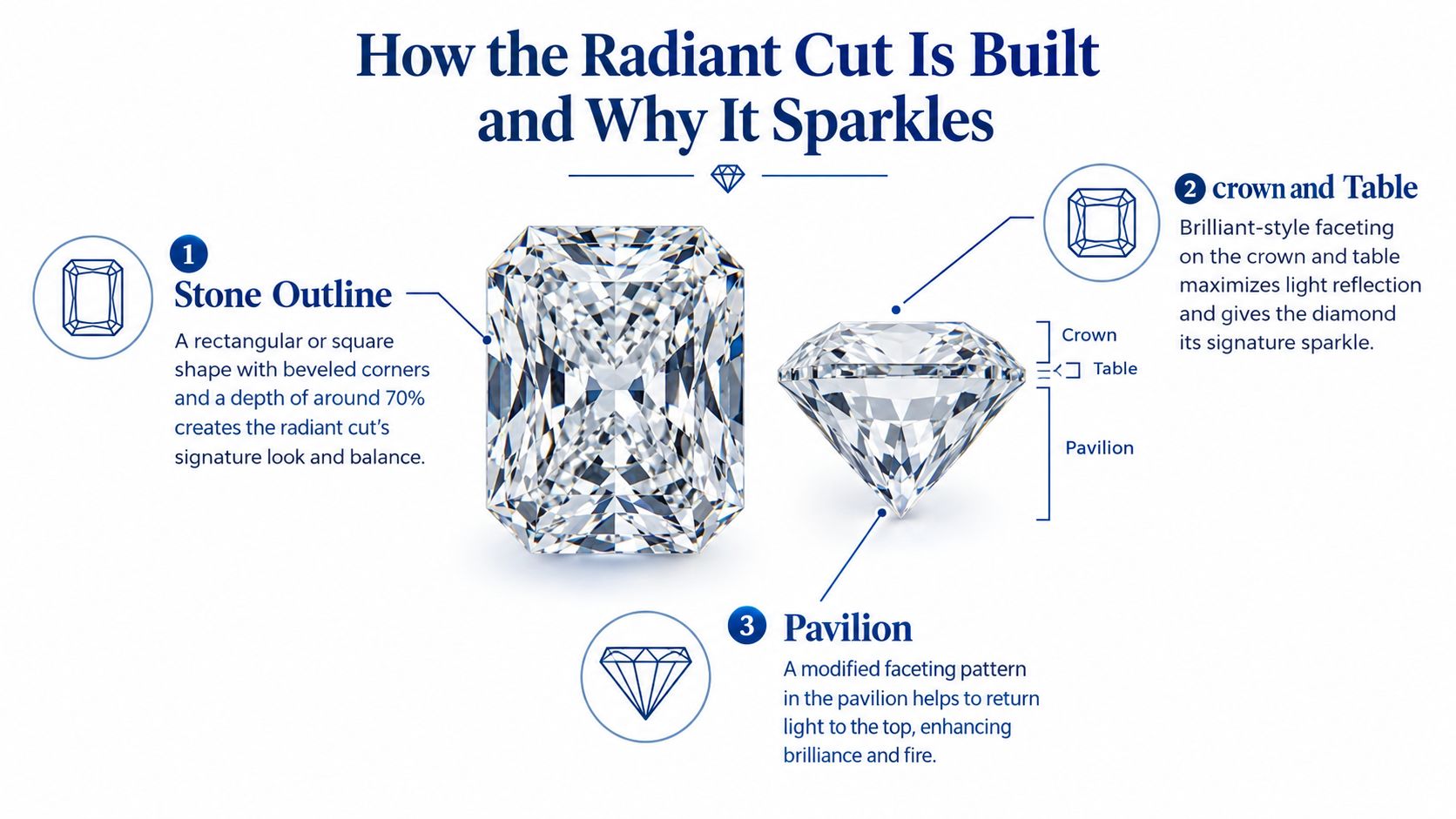
Start with the outline. A radiant is usually rectangular or square, and its corners are beveled rather than left sharp. The shape protects those vulnerable points while giving the stone a broad face-up presence. Traditional descriptions often place the depth around 70 percent, but the report and the stone's actual appearance matter more than memorizing one target.
The cut has two visual systems working together. The crown and table use brilliant-style triangular and kite-shaped facets, which scatter light into small flashes. The pavilion uses modified facets that echo the parallel organization associated with an emerald cut, sending light back toward the viewer through a more structured lower half.
The rectangle-of-mirrors analogy
Think of a shallow tray made from small angled mirrors stacked in two layers. The upper layer breaks incoming light into sparks. The lower layer channels that light upward, creating the radiant's characteristic combination of broad flashes and pinfire shimmer.
That mixed arrangement explains the cut's personality. It doesn't behave like a round brilliant, which is built around a more uniform brilliant pattern, and it doesn't produce the long, hall-of-mirrors flashes of an emerald cut. A radiant gives you an active, crushed-ice appearance that can remain lively as the hand moves through a chapel aisle.
The facet pattern can also soften the visual impact of slight color and inclusions, especially compared with a step cut. That doesn't mean you should ignore the report. A dark inclusion in the wrong location can still show, particularly through the pavilion.
For a visual introduction before you shop, review this guide to what a radiant cut diamond is.
The video below provides another look at how faceting affects a diamond's appearance.
Radiant Cut Against Oval and Emerald at the Same Carat
A carat comparison only helps when the stones are viewed on the finger, not just weighed. At a fixed 2.00 carat, a radiant, oval, and emerald can have noticeably different face-up personalities because each shape distributes weight through its length, width, depth, and pavilion.
A typical radiant may sit around a 1.25 length-to-width ratio, while an oval is closer to 1.40 and an emerald near 1.45. Those ratios make the radiant shorter and broader, so it often reads wider across the finger. The oval stretches farther along the finger, while the emerald emphasizes a long, architectural outline.
| Cut | Typical L/W Ratio | Face-Up Look | Light Pattern | Clarity Demand |
|---|---|---|---|---|
| Radiant | Around 1.25 | Broad rectangle with softened corners | Bright, broken flashes | Moderate, inspect the plot |
| Oval | Around 1.40 | Longer, slimmer outline | Brilliant sparkle with possible bow-tie | Moderate to high, inspect the center |
| Emerald | Around 1.45 | Long, clean rectangle | Broad, glassy reflections | High, open facets reveal more |
What you'll see in the case
An oval commonly shows a bow-tie effect, a darker region across the center caused by the way light returns through its elongated faceting. Some bow-ties are attractive and balanced. Others look visibly dark when the stone turns, so you need to watch the oval from several angles.
An emerald cut presents the opposite challenge. Its broad, open facets create elegant flashes and a glassy hall-of-mirrors effect, but they also make inclusions easier to detect. A radiant's busier pattern generally gives you more visual camouflage.
For a same-day Las Vegas chapel proposal, the radiant usually gives the strongest combination of width, brightness, and tolerance of a mid-tier clarity grade. That's why I'd put it ahead of an oval when the buyer wants broad face-up coverage and ahead of an emerald when the ring must look lively under uneven or dim lighting.
The proportion guidance from independent diamond education places strong-performing rectangular radiants around 1.20 to 1.35, with square stones closer to 1.00 to 1.10 and more elongated examples extending from 1.15 to 1.50, depending on taste. Those ranges are explained in this radiant diamond proportion guide.
Reading the IGI Report on a Lab Grown Radiant
Pull the IGI report onto the counter before you fall in love with the sparkle. I want the loose diamond beside the document, with the report number visible and the measurements easy to compare.
Start at the header. Confirm the report number and the lab-grown disclosure. Then read the comments and identification fields for the growth method, either CVD or HPHT, along with any listed post-growth treatment. IGI reports are useful because they disclose the growth method, treatment information, exact millimeter dimensions, and a clarity plot. Those details help you assess provenance, pricing, and buying risk, as explained in this guide to reading an IGI lab-grown diamond report.
Follow the document in order
- Growth method: Confirm whether the stone was produced using CVD or HPHT. Don't assume the method from the carat weight or appearance.
- Treatment disclosure: Check whether post-growth treatment appears in the report. Treatment can affect color and provenance, so it shouldn't be treated as a minor administrative note.
- Measurements: Use the millimeter dimensions to calculate the length-to-width ratio. The numbers tell you whether the stone will read square, balanced rectangular, or elongated.
- Clarity plot: Look for dark crystals or other inclusions near the pavilion. Those locations can remain visible through the radiant's lower facets.
- Laser inscription: Before setting, match the inscription on the girdle to the report number.
Independent grading guidance also points out that fancy shapes don't receive one overall IGI cut grade in the same way round brilliants do. Radiants require a more individual assessment of proportions, polish, symmetry, and visual performance, as discussed in this IGI certificate reading guide.
CVD stones can show a brownish tint when untreated, while treatment may make them appear whiter. The report must disclose that treatment. Two stones with similar color and clarity grades can therefore differ in appearance, value, and provenance.
For a local starting point, review the available engagement rings in Las Vegas before booking a viewing. The report should be part of the conversation, not an afterthought after the setting is complete.
Carat, Clarity, Color, and Proportions That Matter
Use the four Cs as a filter, not as a scorecard. A radiant can look impressive without carrying the highest grade in every category, but the stone still has to be eye-clean, balanced, and compatible with the metal.
Start with face-up coverage
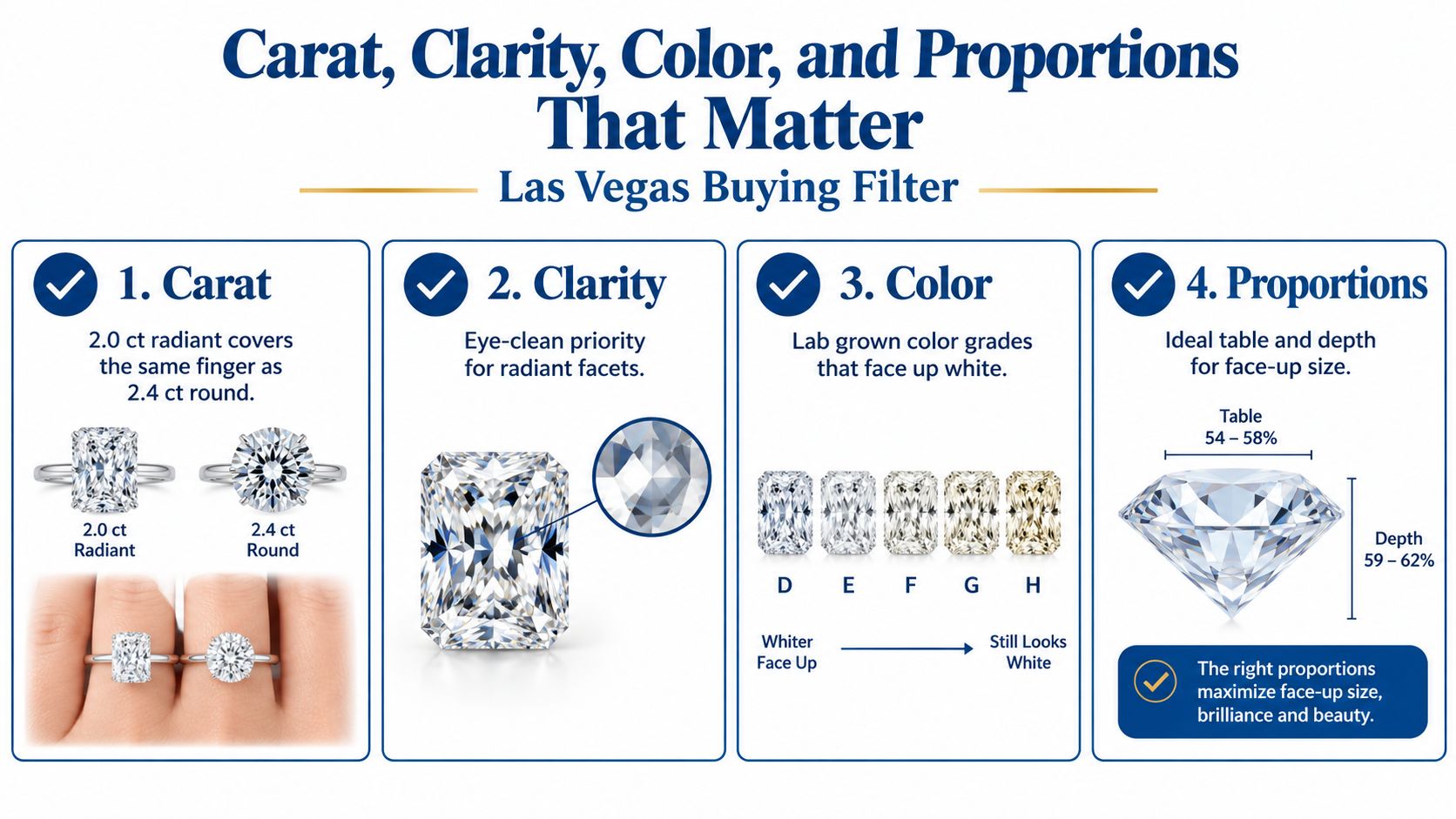
A 2.0 carat radiant can cover roughly the same finger area as a 2.4 carat round, so a buyer focused on visible size may get more presence from the radiant rather than spending up for a larger round. That comparison is a visual buying rule, not a reason to ignore millimeter measurements.
Clarity comes next. I'd start at VS2 or higher and then inspect the actual stone. The crushed-ice pattern hides many feathers and clouds that would stand out in a step cut, but an SI1 can work only when the clarity plot is clean under the table and the inclusion doesn't become obvious in motion.
Match color to the setting
Hold the stone next to the actual mounting metal. G and above is a sensible starting point for platinum or 18K white gold, where faint warmth can be easier to notice. If the ring uses yellow or rose gold, moving toward H or I can make practical sense because the surrounding metal already adds warmth.
Proportions deserve a direct inspection rather than a label-driven purchase. For a clean rectangle, I prefer a length-to-width ratio around 1.20 to 1.30, with depth below 67 percent, plus Excellent polish and symmetry. The broader grading guidance still places many attractive rectangular radiants within a wider range, so don't reject a stone solely because it misses a narrow textbook target.
Use this quick Las Vegas buying filter:
- Carat: Choose the face-up coverage you want, then verify the millimeter dimensions.
- Clarity: Prioritize an eye-clean appearance over chasing a paper grade.
- Color: Compare the loose stone against the finished setting.
- Proportions: Look for a balanced outline, lively light return, and protected corners.
The setting metal is the final adjustment. Platinum and 18K white gold can make faint warmth more noticeable, while yellow and rose gold can visually absorb it. Corner protection matters in every metal, so inspect whether the prongs sit securely over the clipped corners without blocking the stone's outline.
How an In-Stock Las Vegas Shop Compares
Las Vegas buyers usually weigh four paths: a mall jeweler, an online-only seller, a custom designer, or an appointment-only downtown case. Each can work, but they solve different problems.
Mall stores offer a physical showroom and bridal inventory, but the exact radiant you want may not be present when you arrive. Online catalogs provide broad selection and visible specifications, yet shipping and return logistics can eliminate a same-day chapel plan. Custom designers offer more control over the final design, but the process takes longer because the setting must be designed, approved, and finished.
An appointment-only in-stock model sits between those options. The jeweler pre-selects stones, keeps the inventory physically in the downtown case, provides private counter time, and handles the purchase from a real item rather than a supplier listing. The trade-off is narrower selection than a large online catalog.
| Channel | Typical Speed | Price Level | Inventory Breadth |
|---|---|---|---|
| Downtown appointment-only | Same-day viewing and pickup when the item is in stock | Transparent, listed pricing | Curated selection |
| Mall jeweler | Immediate browsing, exact item may require ordering | Varies by store and brand | Bridal stock with rotating selection |
| Online-only seller | Delivery required | Often competitive per carat | Broadest catalog |
| Custom designer | Build time required | Varies by design and materials | Made to specification |
The practical trade-off
If you're proposing tonight, speed and inspection matter more than catalog breadth. If you have time to compare every possible ratio and setting, online or custom shopping may offer more combinations. If privacy matters, an appointment gives you a calmer environment than a busy mall counter.
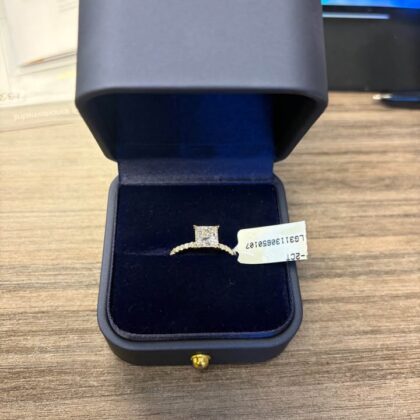
Last Call Rings LV represents the downtown appointment model, with physically in-stock lab-grown engagement rings, listed prices, IGI-certified stones, text scheduling, and a central Las Vegas location. Its approach is described in this guide to what you actually get for your money with lab-grown engagement rings in Las Vegas.
The right choice depends on the deadline. A same-day buyer should avoid confusing an available listing with an available ring. Ask where the item is, whether you can see the report, and whether you can leave with the finished ring after payment.
The Text-Booked Visit from Budget Message to Ring in Hand
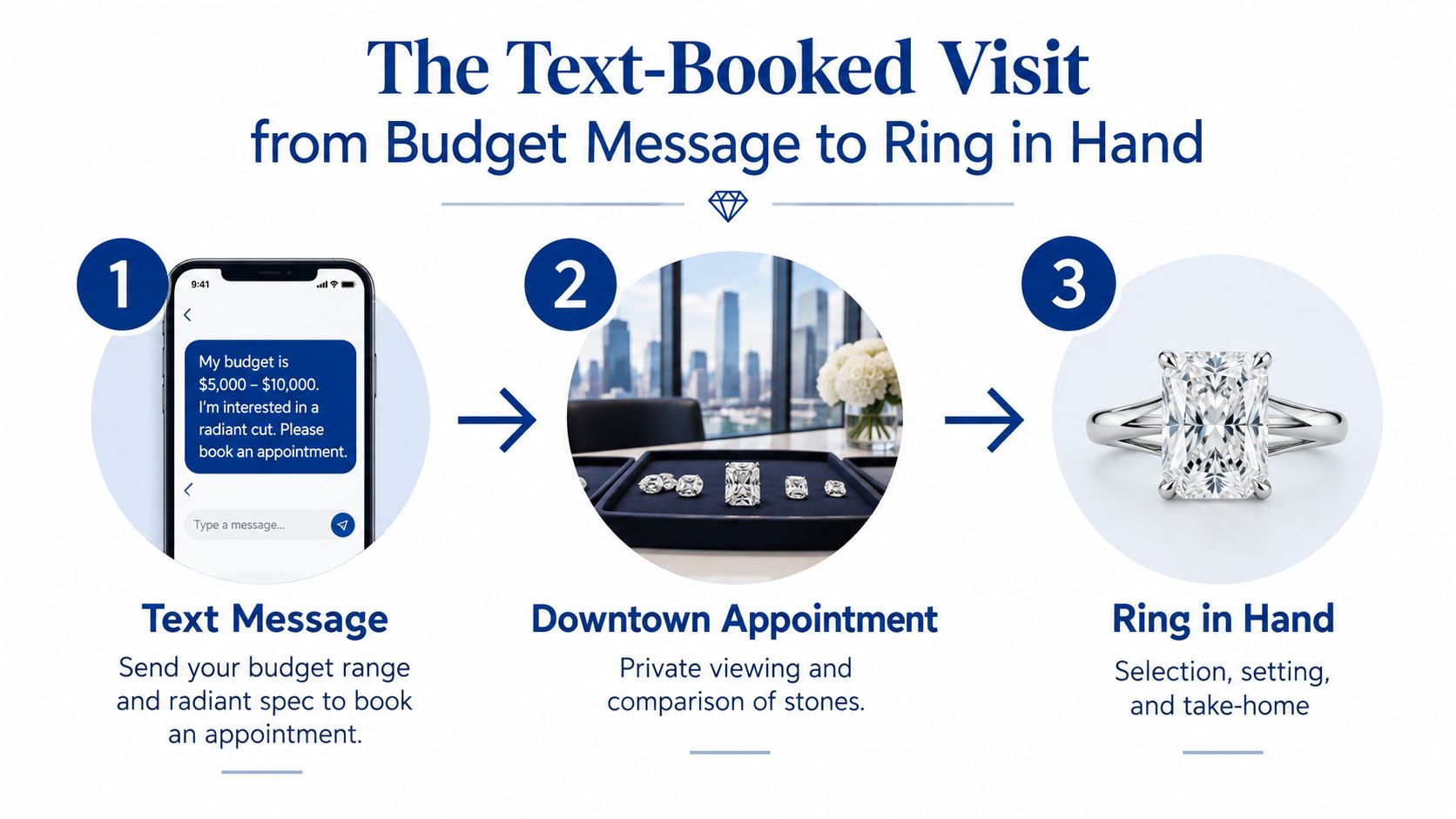
A same-day purchase works better when the jeweler sees your requirements before you arrive. Send a text with your budget range, preferred carat, color and clarity priorities, metal choice, ring size, and proposal timing. Include whether you want a square radiant or a rectangular one.
That message lets the jeweler pull two or three matching in-stock candidates instead of opening an entire case. It also creates a private viewing slot, which is useful when you're moving between the Strip, downtown chapels, and the Marriage License Bureau.
Three steps keep the visit focused
- Text the specifications. State the budget, radiant preference, approximate size, metal, and deadline. Ask the jeweler to confirm which rings are physically available.
- Compare the candidates privately. Review each IGI report beside the stone. Check the clipped corners, face-up pattern, color against the setting, and visible inclusions under both case and store lighting.
- Complete the fitting and payment. Choose the ring that performs best in person, confirm the listed size, pay, and leave with the ready-to-take-home piece.
Plan around the service limits
An appointment-only in-stock visit isn't the same as a full custom bench service. Confirm the ring size before you go because same-day resizing isn't provided on-site. The shop also doesn't provide same-day prong tightening or setting changes, so don't plan to alter the ring between pickup and the ceremony.
If the size needs adjustment, plan a return visit the next morning. That small scheduling detail matters when the proposal is tied to a chapel appointment or a tightly planned evening.
Before you text: Have the budget, desired shape ratio, metal, ring size, and pickup deadline ready. Clear information gets you better candidates faster.
For legal timing, Clark County says the Marriage License Bureau is open 365 days a year, including holidays, from 8 a.m. to midnight, with no appointments, no blood test requirement, and no waiting period in Nevada. The official Clark County marriage license FAQ provides those requirements. The bureau is at 201 E. Clark Avenue, and Visit Las Vegas's marriage guidance confirms the daily hours and location.
Bringing It Together Before You Buy
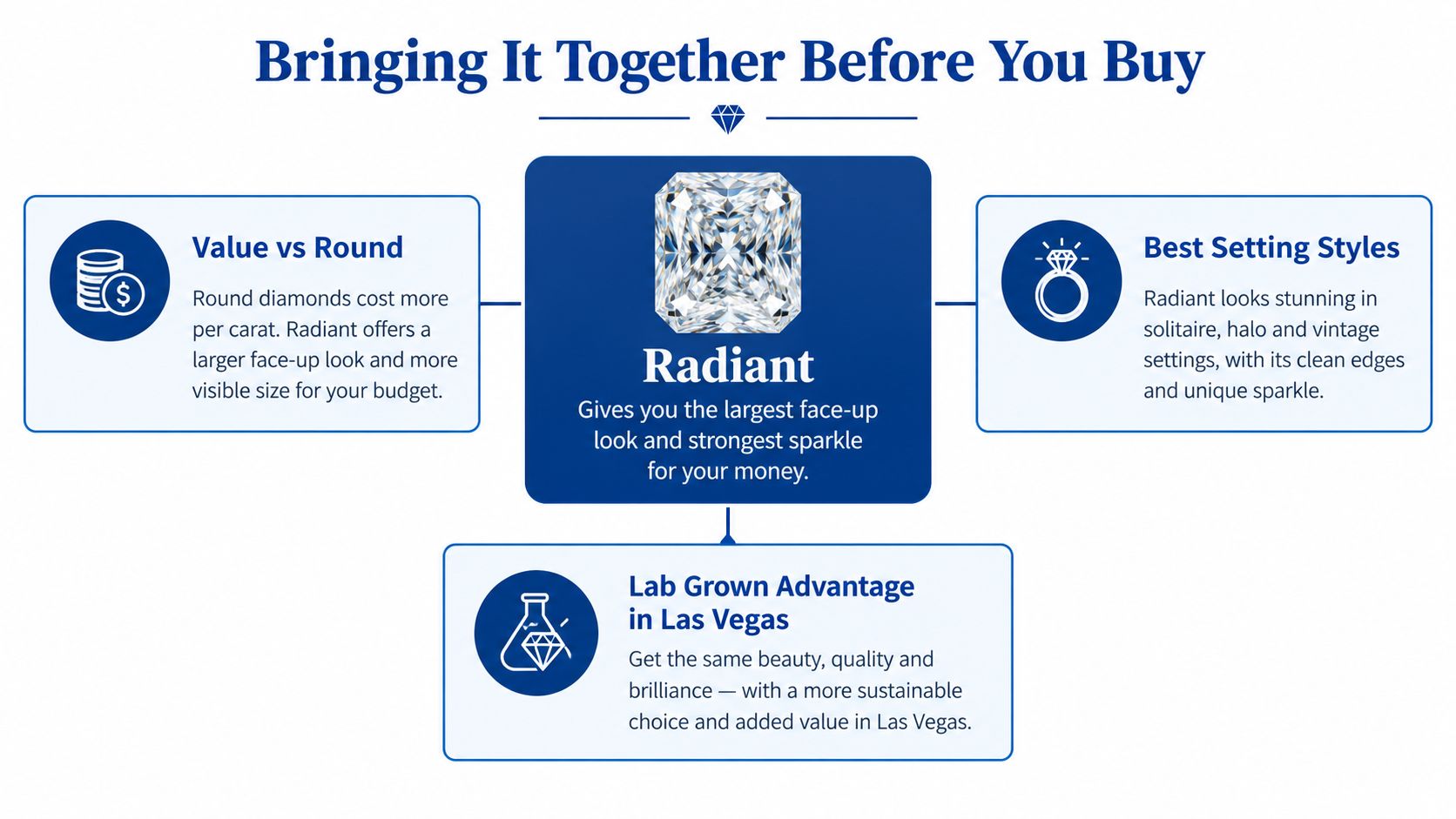
A radiant cut lab-grown diamond ring makes the most sense when you want strong visible coverage, active brilliance, and a ring that can fit a same-day Las Vegas plan. The shape often gives a broader face-up impression than a round at a comparable spending level, while the mixed faceting creates more sparkle than an emerald cut.
The core trade-off is straightforward. You get a bold rectangular outline and lively brilliance, but you must judge the individual stone because fancy shapes don't receive one universal cut grade equivalent to the round brilliant system. Pay attention to the report, the millimeter dimensions, the clarity plot, and how the stone performs in person.
For proportions, decide whether you want a square or rectangular look. Square radiants sit closer to a 1.00 to 1.10 ratio, while a balanced rectangular appearance commonly falls around 1.20 to 1.35. A setting should protect the clipped corners without covering so much of the outline that the stone loses its architectural shape.
Buy for the ring, not a resale story
Lab-grown diamonds have moved from a niche product to a significant part of global supply. Statista reported 16 million carats of new lab-grown supply in 2023, compared with 112 million carats of newly mined natural diamond supply, and another Statista measure placed lab-grown diamonds at 14.3 percent of the worldwide diamond market in 2023. Those figures appear in the IGI laboratory-grown diamond resource.
Market coverage also reports that lab-grown prices have fallen over the past six months and may decline further over the next year, although the movement may not continue in a straight line. Industry projections published for 2026 estimate continued global market expansion, including one projection of about $27.0 billion in 2026 and $56.8 billion by 2033, while another forecasts $59.2 billion by 2032. Treat those figures as forecasts, not guarantees. The practical conclusion is clear: buy the ring because you want to wear it, not because you expect it to behave like a store of value. The recent Las Vegas engagement ring trend coverage discusses the price movement and resale concern.
Use this final checklist:
- Text the budget: Include the carat, ratio, metal, clarity, color, and deadline.
- Book the viewing: Ask for two or three physically in-stock radiants.
- Verify the IGI report: Match the report number, growth method, treatment disclosure, measurements, plot, and inscription.
- Confirm the setting: Check corner protection, metal color, and listed ring size.
- Plan sizing: If the size isn't right, schedule the return visit rather than expecting same-day resizing.
Clark County's official information confirms that Nevada has no waiting period before the ceremony, and a local 2026 marriage-license guide notes that same-evening legal marriages are possible when the bureau's daily hours fit the schedule. Read the Las Vegas marriage-license timing guide before building your proposal itinerary.
Last Call Rings LV offers physically in-stock, IGI-certified lab-grown radiant rings in a private downtown Las Vegas appointment setting, with prices shown before you visit and same-day pickup for ready-to-take-home pieces. Text your budget and radiant specifications, then visit Last Call Rings LV to arrange a viewing that fits your proposal or chapel schedule.