August 24, 2026 · Info
Lab-Grown Diamond Engagement Rings in Las Vegas: What You Actually Get for Your Money
Here is the whole argument in one sentence: the same money buys you roughly three to four times more diamond. Everything below is the detail behind that sentence — what a lab-grown diamond actually is, what the price gap really represents, and the two or three things worth checking before you hand anyone your card.
We sell lab-grown diamond engagement rings in Las Vegas, so we have an obvious interest in what you conclude here. We have tried to write this the way we would explain it across the counter, including the parts that do not flatter us.
A lab-grown diamond is a diamond, and that is not marketing
This is the question behind every other question, so let us settle it first.
A laboratory-grown diamond is carbon arranged in the same crystal structure as a mined diamond. Same hardness — a 10 on the Mohs scale. Same refractive index, which is the physics behind the sparkle. Same everything an instrument can measure, because it is the same material.
You do not have to take a jeweler’s word for it. In 2018 the U.S. Federal Trade Commission revised its Jewelry Guides and removed the word “natural” from its definition of a diamond, on the reasoning that a grown stone has essentially the same optical, physical, and chemical properties as a mined one. The Gemological Institute of America — the organisation that invented the 4Cs in 1953 — grades lab-grown diamonds on that same scale and issues a Laboratory-Grown Diamond Report for them. IGI does the same and certifies the majority of lab-grown stones on the market.
The practical version: a working jeweler cannot tell the difference by eye or with a loupe. It takes dedicated spectroscopic equipment — GIA sells a machine specifically for the job — because the only reliable tells are trace differences in how the crystal grew, not anything you can see.
What is different is origin, and that is the part you should disclose rather than hide. Every stone we sell is described as laboratory-grown, on the listing, on the report, and out loud. More on how we handle that here.
What the price difference actually buys
Lab-grown prices have fallen hard. A one-carat stone that ran around $4,000 in 2020 sits in the high hundreds to low thousands now, because growing capacity in India and China expanded enormously between 2020 and 2024. Prices have largely flattened out since late 2025.
Here is roughly where the two markets sit in 2026 for a well-cut stone in the G–H colour, VS clarity range that most people actually buy:
| Centre stone | Lab-grown, typical retail | Mined, typical retail |
|---|---|---|
| 0.50 ct | $300 – $500 | $1,200 – $1,800 |
| 1.00 ct | $700 – $1,500 | $4,000 – $6,000 |
| 2.00 ct | $1,700 – $3,000 | $15,000 – $20,000 |
Ranges reflect 2026 market pricing across multiple retailers and will move. Our actual prices are printed on every listing.
Notice what happens at two carats. Mined diamond prices climb exponentially with size because large clean rough is genuinely rare. Lab-grown prices climb far more gently. The bigger the stone you want, the wider the gap gets.
Translated into a decision: a $3,000 budget is a half-carat mined stone or a two-carat lab-grown one. That is not a subtle difference across a dinner table. It is the difference between a ring someone notices and one they do not.
Browse what we have in stock, or jump to a budget: under $500, $500 to $1,000, or $1,000 to $2,500.
The part most jewelers leave out
Two honest caveats, because you will find them eventually and you should hear them from us.
Lab-grown diamonds hold their resale value poorly. Industry estimates put recovery around 10–30% of purchase price, against roughly 25–50% for mined stones. Prices have been falling, and there is no scarcity story underneath a lab-grown stone to arrest that.
Whether this matters depends entirely on one question: are you planning to sell it? Most engagement rings are never resold. They stay on a hand, then go in a box, then go to someone’s daughter. If that is your plan, resale value is an abstraction. If you are thinking of the ring as a store of value, buy neither — buy an index fund, and buy a smaller ring.
We are not going to tell you it is better for the planet. You will see “eco-friendly” and “sustainable” all over lab-grown marketing. In April 2019 the FTC sent warning letters to eight lab-grown diamond marketers over exactly those claims, on the grounds that no seller can substantiate every reasonable interpretation of them. Growing a diamond takes serious energy. Whether that beats mining depends on the grid the reactor runs on, and almost nobody publishes that number. Any jeweler who tells you flatly that lab-grown is greener is either guessing or repeating a line they were handed.
What you can say with confidence is narrower and more useful: you know exactly where a lab-grown stone came from, because it has a report from the facility that grew it.
Three things to check before you pay
1. A certificate from a lab you have heard of
IGI or GIA. Both grade lab-grown stones on the same 4Cs scale and inscribe the report number on the girdle of the diamond, so you can verify it later against the lab’s own database. If a seller cannot produce a report number, walk. Our certificate numbers are printed on the listing before you get in the car.
2. The cut grade, above everything else
Cut is the C that determines whether a diamond looks alive. Colour and clarity are grades on paper; cut is what you actually see across a room. Because lab-grown material is cheap, some sellers pour the savings into carat weight and quietly accept a mediocre cut — a big, flat, sleepy stone. Look for Excellent or Ideal, then spend what is left on size.
3. The specification you are actually paying for
Chasing D colour and VVS clarity is where budgets go to die. In the G–H colour and VS clarity range, a well-cut stone is eye-clean and looks white in a setting. Nobody is inspecting your fiancée’s hand with a loupe. Buy the cut, buy the size, and take the middle grades.
Why buy here instead of clicking “add to cart”
Online lab-grown retailers are good, and we will not pretend we beat every one of them on price. What they cannot do is let you look at the thing.
Diamonds photograph unreliably. Every stone on every website is shot under lighting chosen to flatter it, and two stones with identical paperwork can look meaningfully different in daylight. The first time you see it should not be the day you propose.
Then there is the timeline, which in this city is not theoretical. Order a ring from a national chain and you are three to six weeks out. Order online and you are waiting on a courier. If you decided this week — and in Las Vegas, people decide this week — that is a problem no amount of shipping upgrade fixes.
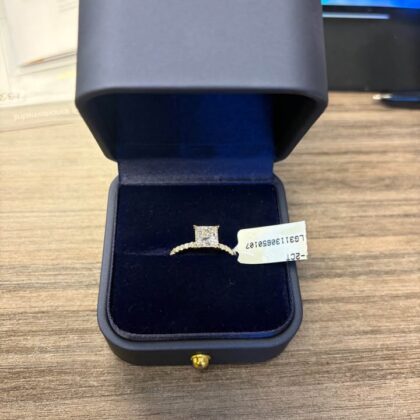
Everything we list as ready is physically in the case downtown, priced, with its certificate attached. You look at it, you pay for it, it leaves with you. See what is in the case right now.
Buying an engagement ring in Las Vegas on a short timeline
A few practical notes if the proposal is soon.
Check the size on the listing. We print the current ring size on every ring, because we do not resize on site. Pick the closest one. If you can get hold of a ring she already wears, that narrows it considerably.
Text before you drive. We run by appointment, which mostly means you get the counter to yourself instead of standing behind a wedding party. Send a budget and anything you know about her taste, and we will have a handful out and waiting. Details on booking are here.
Sort the license separately. The Marriage License Bureau is its own errand with its own hours, and it is a few minutes from us on Fremont Street. Do not assume you can do both in the same twenty minutes.
Common questions
Will she be able to tell it is lab-grown?
Not by looking. Nobody can, without laboratory equipment. But tell her anyway — she will find out eventually, and “I got you twice the stone for the same money” is a good story, while “I hoped you would not ask” is not.
Is a lab-grown diamond the same as moissanite or cubic zirconia?
No, and this is the distinction that matters most. Moissanite and CZ are simulants — different materials that resemble diamond. A lab-grown diamond is diamond. The FTC treats these as separate categories precisely because sellers have blurred them.
Do lab-grown diamonds get cloudy or scratch over time?
No. Same hardness as any other diamond, which is the hardest natural material there is. It will pick up the same film of hand lotion and dish soap as any ring, and it cleans up with warm water, dish soap, and a soft toothbrush.
What can I get for under $1,000?
Around a carat, well cut, in a gold setting — a stone that would have cost several thousand a few years ago. See the rings under $1,000.
Which shape looks biggest for the money?
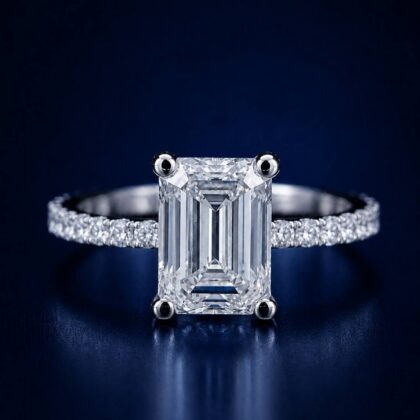
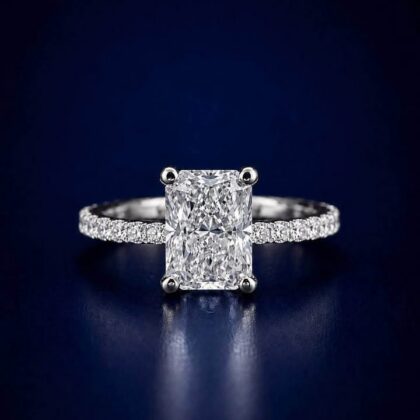
Elongated shapes carry their weight across the finger rather than down into the stone, so ovals and pears generally read larger than a round of the same carat weight. Browse by oval, round, or emerald.
The short version
A lab-grown diamond is a real diamond, graded by the same labs on the same scale, at somewhere between a fifth and a tenth of the price. It is a poor investment and a very good ring. If you were never going to sell it, that trade is close to free.
What we add is that you can hold it today. Have a look at what is in stock, then text us and we will get it out of the case for you.