September 3, 2026 · Uncategorized
2.5 Carat 5 Stone Diamond Ring in Las Vegas
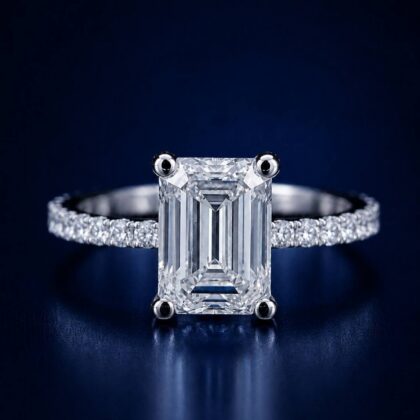
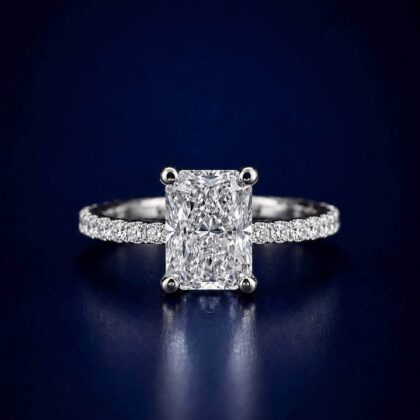
You're in Las Vegas, the ceremony is today, and the ring still isn't handled. You want something that looks substantial across the finger, not a thin placeholder, but you also don't want to gamble on a render that may look completely different in person. A 2.5 carat five-stone diamond ring can solve that problem, but only if you understand how the 2.50 carats are distributed, how the setting wears, and what's ready for pickup at a downtown counter.
For local buyers, the key phrase is same-day, in-person selection. Clark County says no appointment is necessary to obtain a marriage license, the process typically takes less than an hour, and there's no waiting period before a couple can marry after receiving the license. Clark County's official Las Vegas marriage guidance explains why ready-to-take-home jewelry matters here. This guide focuses on the ring itself, so you can walk into a Las Vegas jeweler knowing what the label means and what your hand should see.
Table of Contents
- Why Shoppers Are Choosing a 2.5 Carat 5 Stone Diamond Ring
- How the 2.5 Carats Are Spread Across Five Stones
- Settings That Hold Up to Daily Wear
- Lab-Grown Versus Mined at 2.5 Carat Total Weight
- Buying a 2.5 Carat 5 Stone Ring in Las Vegas
- Cutting Past the Carat Weight in Product Listings
- Checklist Before You Leave the Downtown Counter
Why Shoppers Are Choosing a 2.5 Carat 5 Stone Diamond Ring
At a downtown Las Vegas counter, a couple may arrive with a chapel booking on the phone and need a ring before the day is over. They want visible finger coverage, a finished setting, and a choice they can inspect in person. Start by clarifying the label: does 2.5 carats describe one diamond or the complete ring?
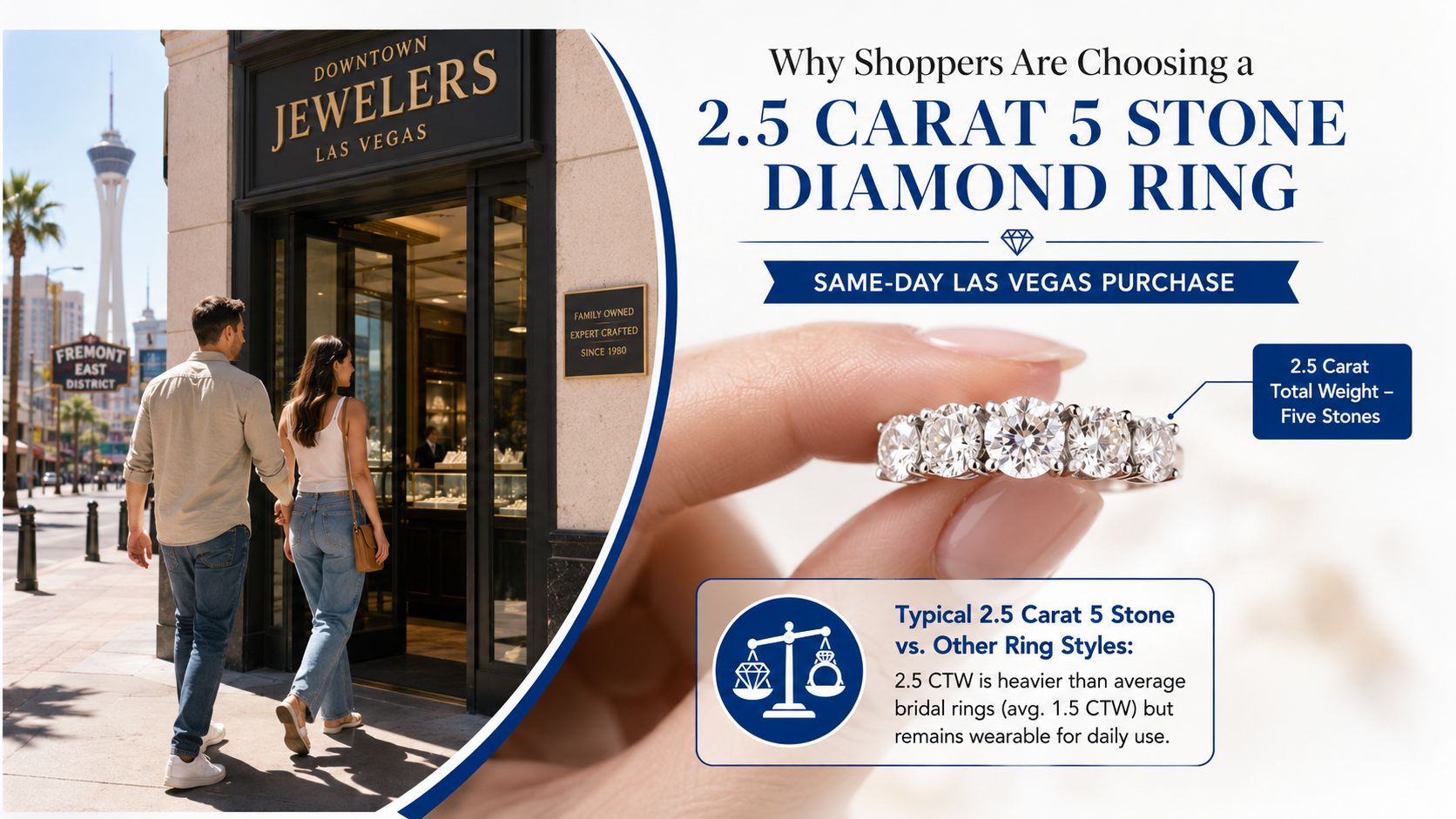
For this design, 2.5 carat total weight, or 2.50 ctw, means all five diamonds together weigh 2.50 carats. It does not describe a single 2.5-carat center stone. An even layout may place five diamonds near half a carat each. A graduated layout assigns more weight to the center and reduces the sizes toward the edges.
Why the layout works for a rushed purchase
The five-stone format suits same-day buying for three practical reasons:
- Wide finger coverage: Five diamonds form a broader line than one solitaire with a similar total weight. From the top, the ring looks substantial because the stones extend across the finger.
- Efficient allocation: Each diamond shares the visual work instead of one center stone carrying the entire impression of the ring. Buyers can direct their budget toward a coordinated row with strong overall brightness.
- Built-in meaning: Five stones can represent five years of marriage or values including love, trust, friendship, loyalty, and commitment. The Victorian-era five-stone ring circa 1913 shows the design's roots in the Victorian era and early twentieth century.
The trade-off appears quickly under a downtown counter's lighting. In an even layout, each diamond is roughly half a carat, so each stone has the visual character of a half-carat diamond. The ring will not create the single-stone presence of a 2.5-carat solitaire. It delivers continuous sparkle and spread, which makes the total look broader across the finger.
Market context supports its bold positioning. U.S. engagement rings have been reported at average total weights of 1.08 carats and 1.16 carats in separate industry reports. A 2.0 to 2.24 carat size band recorded 10% year-over-year sales growth after 18% growth in 2024 and held 12% market share, according to Ritani's engagement-ring carat-weight guide. A 2.5 ctw five-stone therefore reads as an above-average, visibly bold purchase.
For same-day Las Vegas shopping, lab-grown diamonds can make that spread easier to reach, especially when matching stones and width matter more than one large center. Judge the finished ring on your hand, not just the carat number on the listing.
How the 2.5 Carats Are Spread Across Five Stones
Treat the ring as a layout problem. The total number on the tag matters, but the stone-by-stone breakdown controls the silhouette, finger coverage, and balance you see when the ring is on your hand.
The cleanest arrangement is an even split, with five stones close to 0.50 carats each. That creates a uniform row with no obvious center. It reads like a broad diamond band and is easy to understand under jewelry-counter lighting. A benchmark example from Charleston Rings' five-stone sizing guidance shows how total weight can be distributed across five stones, using five 0.40-carat cushion diamonds for a 2.00 ctw design.
A graduated arrangement changes the message. A larger center, often near 0.85 to 1.00 carat, can taper toward smaller outer stones near 0.30 carats. That shape borrows the visual hierarchy of a solitaire while retaining the side-to-side coverage of a five-stone ring. It's a better choice for someone who wants the eye to land in the middle.
The near-graduated layout sits between those two. The center and end stones remain relatively close in size, so the ring still reads as a coordinated row rather than a center diamond with accents. In practice, you should judge the transition on your own hand, because finger width and ring size alter the apparent spacing. On a size 6.5 finger, an even arrangement often produces the strongest horizontal spread, while a graduated arrangement can look taller and more center-focused.
Counter rule: Never approve a 2.5 ctw layout from the total-weight line alone. Put the even, graduated, and near-graduated versions beside each other and compare the actual face-up width.
Side shapes also change the result. Baguettes and trillions can add architectural detail, but part of their weight may sit in dimensions that contribute less visible surface area from above. Ask to see the ring on a try-on tray, then tilt your hand under the case lights. The right layout should look aligned from the top, bright from an angle, and comfortable when your fingers move together.
| Layout | Center Stone | Side Stones | Face-Up Effect | Best For |
|---|---|---|---|---|
| Even | Near 0.50 ct each | Near 0.50 ct each | Widest, most uniform row | Buyers who want continuous coverage |
| Graduated | Near 0.85 to 1.00 ct | Tapers toward about 0.30 ct at the ends | Stronger center and softer edges | Buyers who want a solitaire-like silhouette |
| Near-graduated | Moderately larger center | Small difference from center to edges | Balanced row with subtle focus | Buyers who want structure without a dominant center |
These figures describe layout examples, not a promise that every ring uses those exact proportions. The listing should show the individual weights. If it only says 2.50 ctw, ask for the breakdown before you compare it with another ring.
Settings That Hold Up to Daily Wear
At the downtown Las Vegas counter, a 2.5 carat five-stone ring feels wider and more active on the hand than a render suggests. Five separate diamonds create more edges, contact points, and possible snag points than a solitaire. For same-day wear, judge snag control, comfort, cleaning, and wedding-band fit before you judge sparkle.
Shared prongs keep the row bright by using one prong between adjacent stones. Less metal separates the diamonds, and the profile can remain relatively low. That helps while dealing cards, carrying a gym bag, or pulling on clothing. The tradeoff is concentrated wear. If a shared prong loosens, neighboring stones can lose security, so inspect the setting regularly.
Four-prong settings give every diamond its own support. They show more metal, yet a bench jeweler can inspect and repair each stone independently. They also work well with a curved or notched wedding band because each head can be shaped around the band. For a ring you plan to wear daily, I prefer four-prong construction when repair access matters more than the cleanest possible row.
Comparing the practical options
| Setting | Snag Risk | Comfort & Profile | Band Pairing | Best For |
|---|---|---|---|---|
| Shared-prong | Low to moderate | Slim, bright, usually low profile | Can sit flush with a shaped band | Maximum sparkle and a clean row |
| Four-prong | Moderate | Slightly more structure around each stone | Strong option for curved or notched bands | Buyers prioritizing repairability |
| Bezel | Lowest | Smooth edges and strong protection | Usually easy to wear beside a straight band | Nurses, bartenders, and active hands |
| Low-profile basket or u-prong flush | Low | Secure, compact, and controlled | Best beside a wider band | Buyers planning a substantial stack |
A bezel setting surrounds each diamond with metal, making it the strongest choice for resisting snags. It also changes the visual balance. Covered edges make the ring look less open than a shared-prong design. Choose a bezel when the wearer handles fabric, gloves, tools, or constant hand contact.
Cleaning is simple for all four styles. Use a soft toothbrush, mild soap, and lukewarm water. Rinse carefully, then dry with a lint-free cloth. Shared prongs deserve extra attention because residue settles between adjacent stones. Bezels shield the edges, but the channel around each diamond still needs brushing.
GIA's engagement-ring buying tips recommend professional sizing, careful setting selection, and viewing jewelry under different lighting. Follow that advice at the downtown counter. Try the ring beside the intended wedding band, close your hand, and move your fingers before paying. If the ring rotates or presses against the neighboring finger during a full day, choose a different setting or profile.
Lab-Grown Versus Mined at 2.5 Carat Total Weight
At the downtown Las Vegas counter, I compare these rings by layout per dollar, not by the emotional pull of the word “natural.” A 2.5 ctw five-stone ring spreads its weight across the finger, while a mined solitaire concentrates its presence in one center. The invoice should make that difference visible.
Independent pricing guidance places lab-grown diamonds at roughly 50% to 70% below mined diamonds, with some market guides estimating a gap of 60% to 85% for comparable quality, as described in this lab-grown diamond pricing guide. Those ranges explain why a lab-grown five-stone can offer more visible finger coverage within a similar budget. Do not treat them as a guaranteed quote for the ring in front of you.
The buying decision is straightforward. Choose five coordinated lab-grown stones if you want a broad row of sparkle and control over matching. Choose a mined solitaire if one dominant center matters more than distributed coverage.
What the invoice should help you compare
| Spec | Lab-Grown 2.5 ctw Five-Stone | Mined 2.0 ct Round Solitaire |
|---|---|---|
| Total carat weight | 2.50 ctw across five stones | 2.0 ct in one stone |
| Face-up character | Broad row with distributed sparkle | One dominant center |
| Color and clarity strategy | Can prioritize coordinated, eye-clean stones | Grade differences can have a larger budget effect |
| Main visual advantage | Finger coverage and balanced brilliance | Single-stone presence |
| Main practical question | Are the five stones matched and aligned? | Is the center cut strong enough to justify the weight? |
Do not buy from the carat total alone. For a 2.5 ctw five-stone, inspect each stone's cut, shape, measurements, and certificate. G to I can provide a near-colorless face-up appearance, while VS1 or better can support an eye-clean look, but the row still needs consistent matching. Five attractive stones can look disjointed if their outlines or brightness differ.
A lab-grown ring may look wider and brighter across the finger than a mined solitaire with similar spending. The paperwork cannot show whether the row rotates, whether the outside stones sit comfortably, or whether the band catches on clothing. At a same-day downtown fitting, hold both options, close your hand, and view them under the counter lighting and in daylight before deciding.
For the wider value comparison, read this guide to lab-grown diamond engagement rings in Las Vegas. It helps separate the lab-grown price advantage from the design, setting, and inspection factors that determine what you take home.
Buying a 2.5 Carat 5 Stone Ring in Las Vegas
A same-day purchase should feel organized, not frantic. Start by texting a photo, screenshot, or style reference to the jeweler. Include your ring size, metal preference, desired shape, and budget. The counter should reply with a short group of options, not an endless catalog.
For a 2.5 ctw target, ask to see at least one shared-prong design and one bezel or low-profile design. The comparison tells you more than a product render. Put both rings on the intended finger, close your hand, and check whether the outside stones extend comfortably across the top without pressing into the neighboring fingers.
What's usually ready and what may take longer
In a physical case, shared-prong five-stones in lab-grown diamonds are generally the most likely format to find ready for viewing. Graduated five-stones and half-eternity bands are more likely to require an order because their stone matching and proportions are more specialized. Never assume “available” means “ready today.” Ask whether the piece is physically in the case, held in the safe, or still coming from a supplier.
Read every line of the listing:
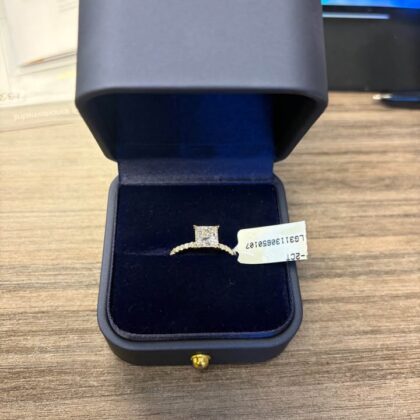
- Total weight: Confirm whether the tag says 2.50 ctw and whether the stones have an individual breakdown.
- Stone identity: Check whether the diamonds are lab-grown or mined, and whether the description applies to all five stones or only one.
- Metal stamp: Look for the stated gold or platinum marking inside the band.
- Report details: Ask whether a GIA or IGI report accompanies the stone or stones, and whether the report number appears on the listing.
- Size status: Confirm the exact ring size before driving downtown, especially because on-site resizing isn't offered by every appointment-only jeweler.
The local advantage is speed without guesswork. Las Vegas chapels advertise same-day ceremonies, walk-in or expedited services, and extended hours, as shown by Paradise Wedding Chapel's same-day wedding information. That creates real demand for a ring that can be viewed, sized for fit, cleaned, documented, and taken away during one visit.
For broader local shopping context, see engagement rings in Las Vegas, Nevada. The right appointment ends with the buyer holding the exact ring, reading the paperwork, and knowing whether the band leaves that day or requires a later pickup.
Cutting Past the Carat Weight in Product Listings
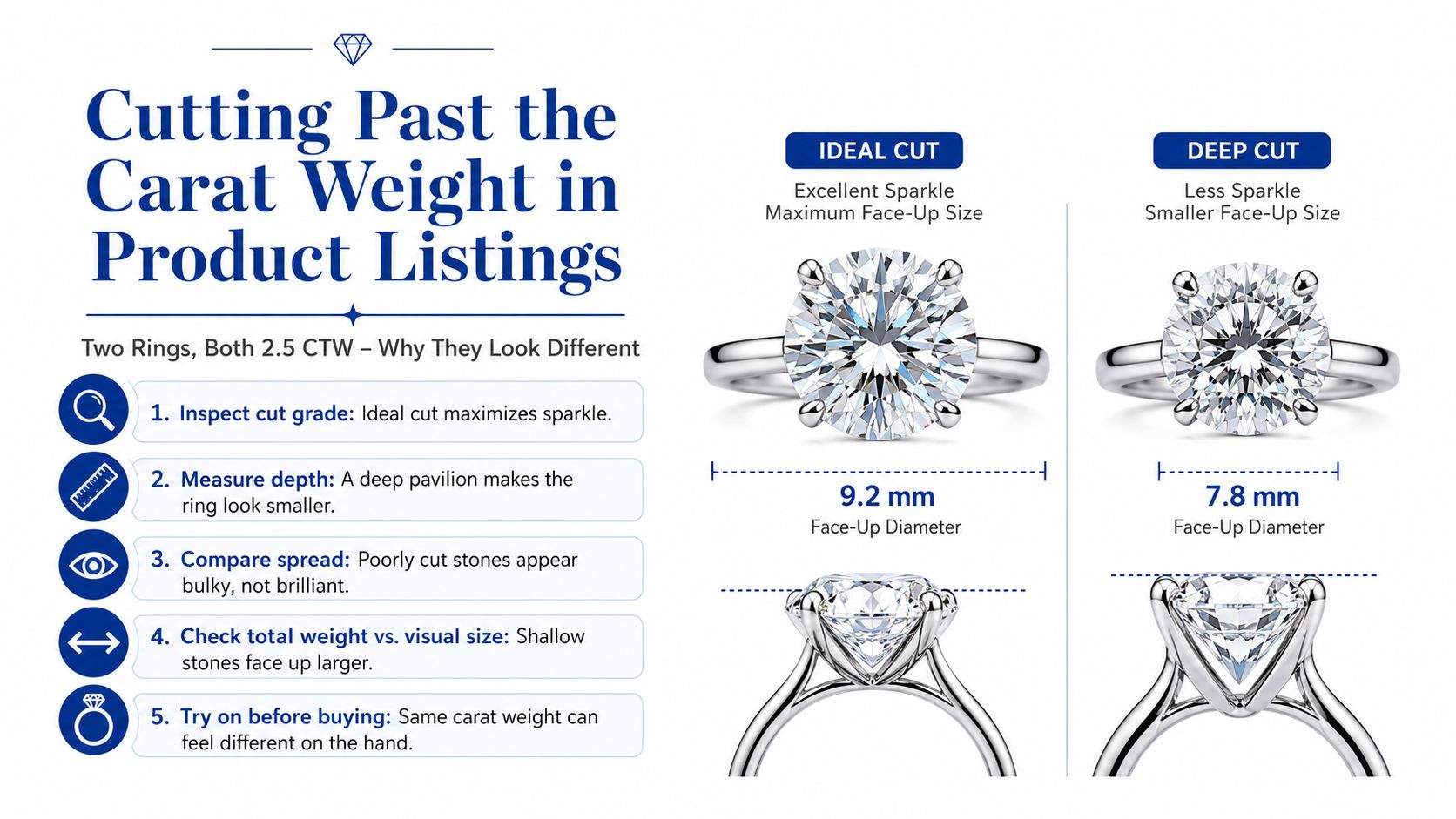
Two rings can both list 2.50 ctw and look completely different on the hand. Total carat weight records the combined diamond weight. It does not show face-up width, alignment, light return, or how much metal breaks up the row.
At our downtown Las Vegas counter, the five-stone format is a layout problem. The same total weight can appear broad and open when spread across well-proportioned stones, or compact when weight sits below the visible surface. Deep pavilions, thick girdles, and mismatched proportions can make a heavier ring look smaller than a lighter, better-cut design. Inspect the actual ring before paying, then compare the paperwork with what you see.
Five checks to make under the counter lights
- Review table and depth: Read the measurements on the GIA or IGI report. Excessive depth can place weight beneath the stone instead of adding visible spread. For a closer look at how proportions affect face-up size, see this diamond cut comparison infographic.
- Check symmetry: The five stones should create a controlled, even line. Unequal angles or visibly different shapes make the ring look assembled rather than designed.
- Watch the plane: Hold your hand level, then tilt it toward the case lights. The stones should sit together instead of tipping in different directions.
- Inspect prong alignment: Shared prongs should repeat in a consistent rhythm across the top. A crooked prong points to weak finishing and can affect stone security.
- Measure the metal gaps: Heavy metal between stones reduces the visible width. Slim spacing can make the row look more continuous, provided the settings still protect each diamond.
A render cannot answer these questions. For a same-day Las Vegas purchase, hold the ring, rotate it under the counter lights, and compare it with another five-stone layout before money changes hands. Look for bright return across all five stones, not a single strong flash from the center.
Practical rule: Buy the ring that looks broad, aligned, and bright in your hand. Use the total-weight line to confirm the layout, not to choose it.
Checklist Before You Leave the Downtown Counter
The last five minutes at the counter protect you from the mistakes that happen when a ceremony, proposal, or flight is close. A five-stone ring needs more verification than a solitaire because the seller is describing multiple diamonds, multiple settings, and one combined weight.
Eight confirmations for a same-day purchase
- Match the weight: The receipt, inner-band stamp, and laboratory documentation should agree on the stated total weight. For a lab-grown ring, confirm how the report identifies the center and side stones.
- Measure the fit professionally: Use a professional sizer and a mandrel, not only a plastic sizing strip. A wide five-stone can feel tighter than a narrow solitaire, so move your hand before accepting the size.
- Test every prong: Have the jeweler check each contact point with a pin push. A visual glance isn't enough to confirm that all ten prongs are secure.
- Read the policies: Confirm the return, exchange, warranty, and resize terms in writing. Lab-grown stones may have a separate exchange policy.
- Save the report information: Photograph the certificate number, inscription, and receipt with your phone before leaving.
- Confirm the appraisal date: Ask whether the appraisal reflects the purchase date so you can arrange insurance without confusion.
- Ask about maintenance: Get the jeweler's recommendation for cleaning, rhodium replating if applicable, and prong inspection or retipping.
- Clarify pickup status: Make sure “same-day pickup” means the exact ring is leaving the case with you, not that an order has been placed.
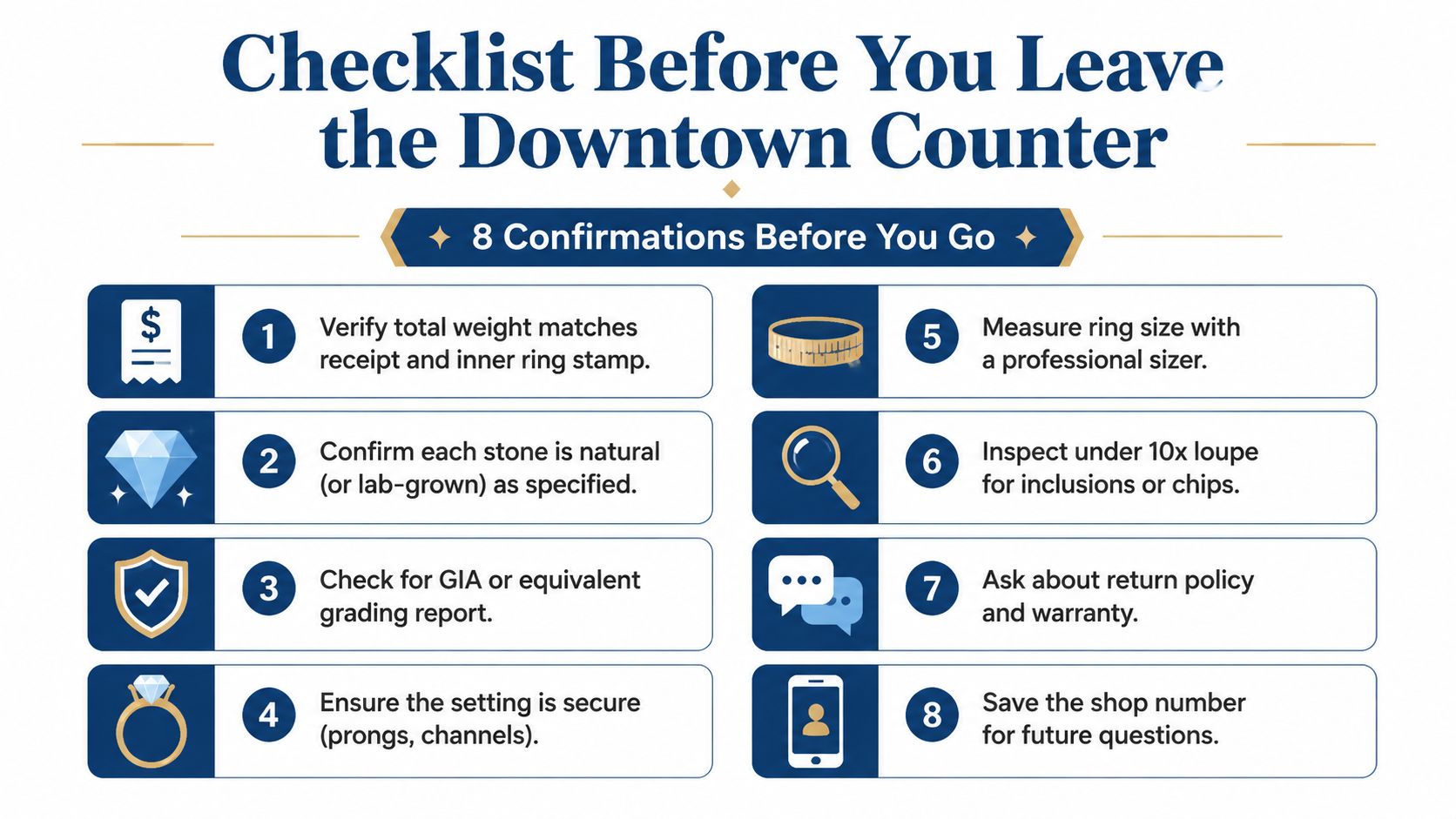
The grading report matters because a 2.5 ctw label isn't a substitute for documented stone identity and quality. Buyers comparing certified options can use IGI-certified rings as a starting point, then still inspect the actual ring and setting in person.
Before you leave, confirm the exact size, the permitted sizing limits, the return terms, the report numbers, the metal, the total weight, the setting security, and whether the ring is physically ready. None of those checks should be skipped because the chapel appointment is close.
If you're shopping for a 2.5 carat five-stone diamond ring in Las Vegas, Last Call Rings LV offers appointment-only, same-day viewings of physically stocked lab-grown rings with transparent pricing and certification details. Text your preferred layout and ring size, then visit Last Call Rings LV downtown to compare the ring on your hand and leave with the right ready-to-take-home option.