September 20, 2026 · Uncategorized
2 Carat Round Diamond Solitaire Ring: A Las Vegas Guide
You're probably not reading this from your couch with six weeks to think. You're in Las Vegas, or you're landing soon. Maybe the chapel is booked, maybe the dinner reservation is locked, maybe you've got one open window between the airport and Fremont Street to buy the ring. That's exactly when the 2 carat round diamond solitaire ring comes up. It's the safe choice, the classic choice, and if you buy it right, it still looks sharp in person and in photos.
But most buyers ask the wrong first question. They ask, “Can I get a 2 carat round?” What they should ask is, “How big will it look on the hand, and what am I paying for that look?” In Las Vegas, where same-day proposals and chapel weddings are common, that question matters more than online window-shopping theory. You need a ring that's physically in the case, priced clearly, and ready to leave with you.
Table of Contents
- What a 2 Carat Round Diamond Solitaire Ring Actually Is
- Cut and Clarity Priorities for a 2 Carat Round Solitaire
- Lab Grown vs Mined Pricing for a 2 Carat Round Solitaire
- Setting Options That Match a 2 Carat Round Center Stone
- Why the 2.00 Carat Mark Is Not Always the Best Visual Buy
- Planning a Same Day Visit Around a Las Vegas Proposal
- Pre Visit Checklist for a 2 Carat Round Solitaire Purchase
What a 2 Carat Round Diamond Solitaire Ring Actually Is
Friday, 4 p.m. You've got a chapel reservation waiting, luggage still in the car, and you walk into a downtown Las Vegas jeweler hoping there's one ring in the case that solves the whole problem. That's the life version of this purchase.
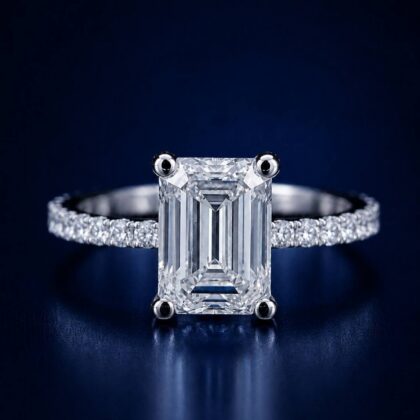
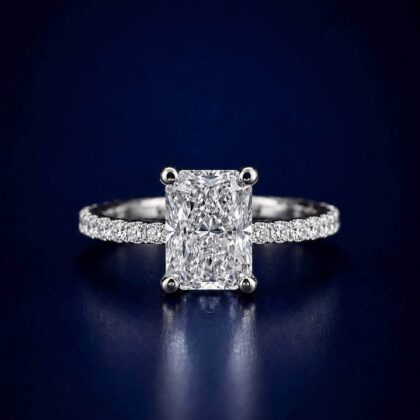
A 2 carat round diamond solitaire ring is simple. It's one round brilliant diamond, usually right at or near the 2.00 carat mark, set by itself with no halo, no side stones, and no accent diamonds pulling your eye away from the center. If you want the cleanest engagement ring look, this is it.
What the buyer actually sees
One carat equals 200 milligrams, so two carats is still a very small object in pure weight terms. On the hand, though, it doesn't read small because the round brilliant cut spreads that weight into a balanced face-up shape.
A 2 carat round brilliant is about 8.1 mm across according to 2026 engagement ring trend coverage. That 8.1 mm number matters more than the carat number once the ring is on a finger. People don't see the grading report first. They see diameter, sparkle, and how the ring sits.
Why round brilliant still works
Round brilliant dominates solitaire rings because it's built for light return. It's the shape buyers recognize fastest, and it usually gives the most familiar bright white sparkle people expect when they say “diamond ring.”
A round solitaire is the ring version of a white shirt that actually fits. Simple doesn't mean boring. It means there's nowhere for a bad stone to hide.
That matters in Las Vegas because clean white light tends to photograph well, especially in a sunset proposal or chapel shot. If you're comparing shape options before you come in, this overview of engagement ring shapes and cuts helps sort the visual differences quickly.
What you'll usually see at the counter in Las Vegas
In a real in-person appointment, expect the basics:
- Certification: Most buyers will see IGI or GIA paperwork
- Metal choices: Usually 14K or 18K in white, yellow, or rose
- Setting style: Most often a plain solitaire mount with prongs
- Visual size: About 8.1 mm face-up for a true 2 carat round
The two sourcing paths are straightforward. You're either looking at a mined diamond or a lab-grown diamond. Both can give you the same classic solitaire look. The rest of the decision comes down to cut, visual spread, price, and whether you care more about origin or value.
Cut and Clarity Priorities for a 2 Carat Round Solitaire
If you're standing at the counter with two round diamonds and one looks alive while the other looks sleepy, the difference is usually cut before it's anything else. Start with the report. Then look at the stone.
The numbers that matter first
For round brilliant performance, the practical target band is 54 to 58 percent table, roughly 59 to 62.5 percent total depth, and crown and pavilion angles near 34 to 35 degrees and 40.6 to 41.0 degrees based on independent round diamond proportion guidance. Those numbers aren't trivia. They're the difference between a bright stone and one that carries dead weight.
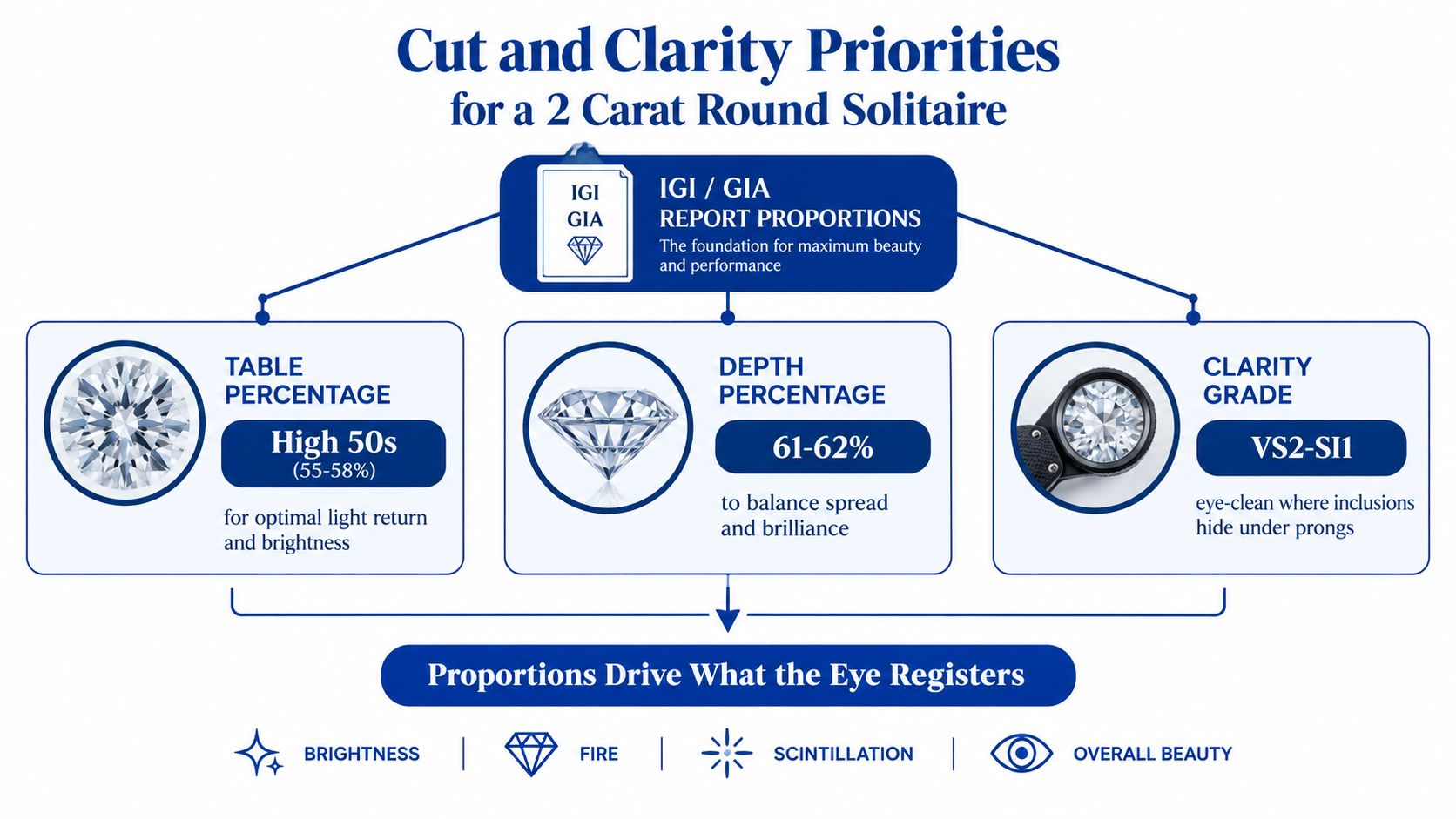
Ask for the table percentage, the depth, and the finish grades. If the report says Excellent or Ideal for polish and symmetry, that's the right place to start. Then check whether the stone looks bright from edge to edge under one consistent lamp.
Why cut beats weight on its own
Think about a grocery bag. A full, well-packed bag looks bigger than a sloppy bag with the same amount inside. Diamonds work the same way. Cut decides how full the stone looks from the top.
A poorly cut 2 carat round can carry too much weight in the belly, too much in a thick girdle, or too much in bad angles that kill brightness. A well-cut stone with slightly less paper weight can easily look more impressive on the hand.
Practical rule: buy spread and light return first, then buy the report number.
If you want to compare how buyers stretch budget in larger-looking lab-created rings, this page on a 3 carat lab-grown diamond ring gives useful context on where appearance-per-dollar starts to shift.
Clarity that makes sense in real life
Here's my rule. If a stone is eye-clean, don't pay extra just to impress the certificate. At this size, VS2 is a strong safety zone because inclusions are easier to spot in a 2 carat diamond than in a smaller stone. SI1 can also be a smart buy if it's eye-clean and the inclusion sits where a prong can hide it.
What I wouldn't buy:
- I1 clarity with a center-table inclusion because you'll keep seeing it once you know where it is
- Strong blue or green fluorescence in a high-color round if the stone goes hazy
- A thick girdle on an “Excellent” cut because hidden weight doesn't help the face-up look
The side-by-side test
Don't buy from paper alone. Ask to see two stones under the same lamp, same distance, same setting tray. Compare a higher-color round against an I-color option and stop staring at the grade first. Look at the one that visually disappears into brightness and doesn't show dirt, shadows, or obvious inclusions.
That's the one to remember.
Lab Grown vs Mined Pricing for a 2 Carat Round Solitaire
If you're shopping in Las Vegas and want to leave with a ring today, price changes the whole decision faster than philosophy does.
A 2 carat round natural diamond with G color and VS2 clarity sits around $18,495 on one 2026 price tracker, or about $9,248 per carat, while another live market index placed the same category near $19,914 in mid-September 2026 with a 1-month change of -0.47%. A separate 2026 guide also reported that typical natural 2 carat round diamonds with G color and VS2 clarity often list in the $15,000 to $20,000 range, while higher-quality D-F stones can rise above $50,000 according to current 2 carat pricing data.
For lab-grown, the gap is huge. A September 2026 comparison reported that 2 carat round lab-grown diamonds averaged about $1,413, with prices ranging from $136 to $6,920 across 40,768 verified listings from 18 retailers. The same source reported a median of $1,149, and a broader 2 carat lab-grown index across all shapes averaged $1,408 with a 2.9% monthly decline according to the 2026 round lab-grown price comparison.
2 Carat Round Solitaire Pricing Comparison
| Spec | Mined | Lab-Grown |
|---|---|---|
| 2 carat round benchmark | Around $18,495 to $19,914 depending on source | Average about $1,413 |
| G color VS2 natural market guide | Often $15,000 to $20,000 | Not the same grading frame used in the cited lab average |
| Higher quality range | D-F natural stones can rise above $50,000 | Listed range in the cited market runs from $136 to $6,920 |
What I recommend buyers do with that gap
If your budget is fixed, lab-grown forces a practical question. Do you want your money tied up in origin, or do you want it showing on the hand?
In Las Vegas, a lot of buyers don't care about the long debate once they see the visual result. They care that the ring is bright, certified, and available now. One local option built around that model is lab-grown diamond engagement rings in Las Vegas with transparent pricing, where the inventory is already in the case rather than ordered after the fact.
The smart buyer doesn't ask whether lab-grown is cheaper. It is. The real question is whether the price difference changes what you can actually wear today.
There are still caveats. Lab pricing has been moving down. Mined tends to hold a different position in the secondary market. And in everyday showroom practice, IGI is common for lab-grown, while GIA remains common for mined. But if you're buying for visible value in Las Vegas, this price gap is the center of the whole decision.
Setting Options That Match a 2 Carat Round Center Stone
A 2 carat round needs a setting that doesn't fight it. You don't need prestige language here. You need a setting that suits the hand, the lifestyle, and how hard the ring will be worn.
The three settings that make the most sense
For a plain solitaire in 14K gold, I keep coming back to three styles: six-prong classic, four-prong slim cathedral, and bezel.
| Setting | Prong Count | Profile Height | Best For | Light Return | Daily Wear |
|---|---|---|---|---|---|
| Six-prong classic | Six | Higher | Traditional look, secure hold | Strong top light performance | Good if wearer is careful |
| Four-prong slim cathedral | Four | Medium to high | Taller visual look, cleaner outline | Strong, open presentation | Good but a bit more exposed |
| Bezel | None in the usual sense | Lower to medium | Active lifestyle, edge protection | Slightly more closed-in look | Strong for daily wear |
What each one actually does
The six-prong classic is still the default for a reason. It frames a round stone cleanly, holds it securely, and keeps the look traditional. It usually sits a bit higher and lets the center stone stay the main event.
The four-prong slim cathedral is the one I like for buyers who want the ring to read a little taller on the hand. It gives more open outline around the stone, and some people think that makes the round look slightly bigger. It's elegant, but it's also a little more exposed.
The bezel is the practical pick. It wraps the edge, protects the girdle, and handles daily knocks better. The tradeoff is obvious. You give up some airy lightness and some visual sharpness in exchange for protection.
My plain recommendation
- Choose six prongs if the wearer wants classic and doesn't want to overthink it.
- Choose a slim cathedral if hand presence matters and the ring needs a little extra lift.
- Choose bezel if the ring will get worn hard every day.
Lifestyle should decide this, not status. A nurse, bartender, stylist, or anyone rough on their hands may hate a high-set solitaire no matter how pretty it looks in the box. A careful wearer who loves a traditional engagement ring will usually be happiest with prongs.
Why the 2.00 Carat Mark Is Not Always the Best Visual Buy
A lot of buyers get trapped by the report. They want to hit 2.00 carats because it sounds complete. Nice round number. Strong bragging rights. Clean line on the certificate.
That's not always where the best buy sits.
Millimeters matter more than the headline number
The better way to shop a round diamond is by face-up spread, not by chasing the exact threshold. As covered earlier, a 2 carat round is about 8.1 mm across. That's what people see.
If a slightly under-2-carat round is cut well and faces up close to that same visual size, the hand won't know the difference. The eye won't know the difference. Only the report will.
Ask for target diameter first. Ask for target carat second.
Why this matters more now
Independent 2026 guidance noted that the average lab-grown engagement ring purchase is around 1.8 carats and that lab-grown diamonds have crossed 50% of new engagement-ring sales, which tells you buyers are already optimizing for look and budget instead of blindly locking onto exact milestone weights according to this 2 carat solitaire buying guide.
That matches what happens at the counter. Buyers think they want the report number. Then they compare two rings on the hand and pick the one that looks larger, brighter, or cleaner for the money.
My opinion on the smart buy
If you're budget-sensitive, stop saying “I need exactly 2 carats.” Say this instead: “I want a round solitaire that looks like a full 2 carat on the hand.”
That one sentence usually leads to a better ring.
Planning a Same Day Visit Around a Las Vegas Proposal
Las Vegas is one of the few places where this can all happen in a single day without feeling chaotic, if you line it up correctly. The key is to shop like someone on a clock, not like someone building a spreadsheet.
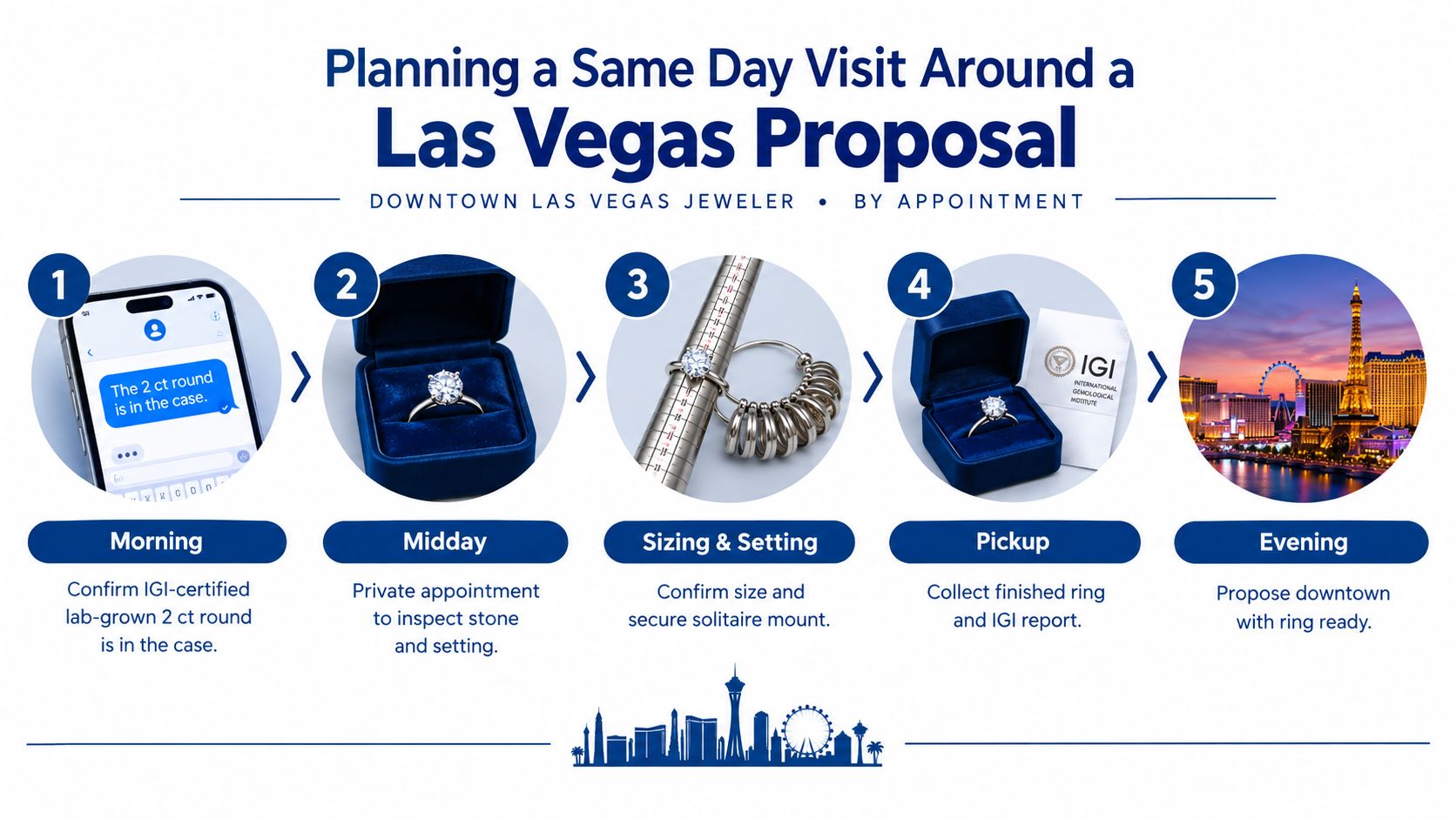
Start with a morning text. Confirm that the ring you want is physically in the case and available to view by appointment. If you're focused on a lab-grown round solitaire, ask for the report number, the ring size, and a clear photo before you get in the car.
The appointment flow that works
When you come in, keep the visit focused:
- Confirm the stone first. Check brilliance, spread, and whether the color reads clean to your eye.
- Check the setting second. Make sure the profile, prongs, and metal color suit the wearer.
- Verify the paperwork. Match the report details to the actual ring before payment.
- Leave with the ring ready. If you're on a same-day schedule, buy what fits the plan now.
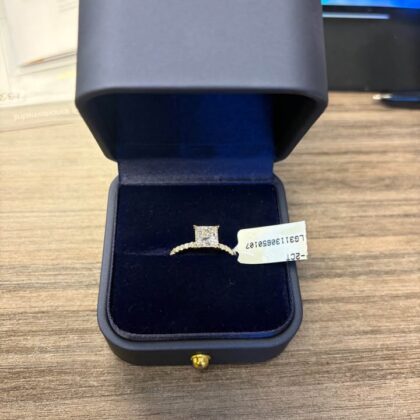
A by-appointment downtown Las Vegas jeweler should be able to make that process fast because the point isn't to browse forever. The point is to inspect, decide, and move.
This quick video gives a feel for the kind of proposal pace buyers are often working around in Las Vegas:
How it fits with the marriage license schedule
The Clark County Marriage License Bureau is at 201 E. Clark Avenue in downtown Las Vegas and is open 7 days per week from 8 a.m. to midnight, including all holidays according to the Clark County Clerk location and hours page.
Nevada also allows same-day marriage licensing and ceremony timing with no mandatory waiting period before the ceremony, and Visit Las Vegas guidance states that couples can receive a marriage license and get married the same day based on Las Vegas marriage license information.
If you want the easiest timing, the Clark County Clerk FAQ says the bureau is typically least busy on Sundays and Tuesdays, with the lightest windows being 8 to 10 a.m. and 8 p.m. until midnight according to the county FAQ on marriage license timing.
The cleanest same-day sequence
Use this order if you want less stress:
- Morning: confirm ring availability by text
- Late morning or early afternoon: private viewing and purchase
- After that: pick up the marriage license downtown
- Then: chapel, photographer, dinner, proposal, or ceremony
Keep all of it in one phone thread if you can. Ring appointment, chapel reservation, and photo timing need to line up cleanly or you'll waste hours driving in circles.
Pre Visit Checklist for a 2 Carat Round Solitaire Purchase
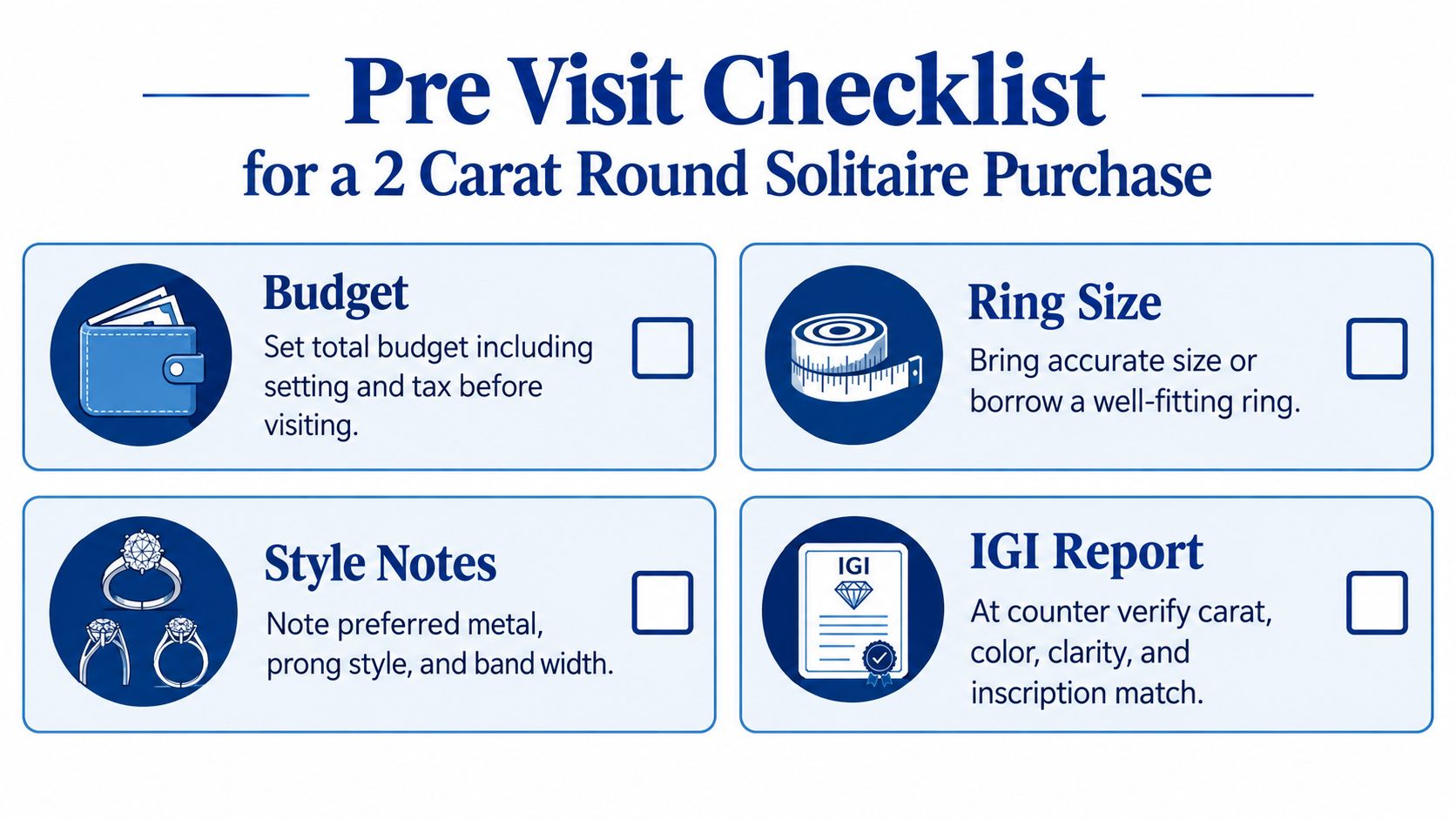
If you show up unprepared, you'll burn time on basic decisions that should've been made before you parked. A same-day ring visit in Las Vegas works best when you walk in knowing your floor, not just your dream.
Money
Decide your total spend before you text for an appointment. Include the center stone, setting, and whatever else matters to you. More important, set your priorities in advance.
- Know your ceiling: give the jeweler a real top number, not a vague range
- Pick your minimums: decide the lowest color or clarity you'll accept
- Settle the origin question early: if lab-grown is on the table, say so before you arrive
Finger
Surprise proposals fall apart on sizing all the time. Get the best information you can before the visit.
- Borrow a ring that already fits if the wearer has one for the correct finger
- Bring a backup estimate if you're not fully sure
- Accept that ready-today matters when on-site resizing isn't part of the model
Bring the most accurate size information you can, but don't let a perfect-size fantasy stop you from buying the right ring that's actually available.
Taste
Don't walk in saying “anything classic.” That wastes everyone's time. Bring clear preferences.
- Metal choice: white, yellow, or rose
- Setting preference: six-prong, four-prong cathedral, or bezel
- Reference images: two or three examples are enough. More than that usually muddies the call.
A buyer with even a rough style direction makes faster, better decisions. That matters in a private appointment where you're trying to leave with the ring, not start a research project.
Paperwork
Before you hand over payment, check the report against the ring in front of you.
Look for these basics on the certificate:
- Report number
- Carat weight
- Color grade
- Clarity grade
- Measurements in millimeters
- Laser inscription on the girdle if present
Take a photo of the report. Then take a photo of the ring. Do it before the box closes.
That sounds obvious, but people skip it when they're excited or rushed. Don't be that buyer.
Last Call Rings LV is a by-appointment Las Vegas jeweler focused on in-stock lab-grown engagement rings that are physically in the downtown case and available for same-day purchase and pickup. If you want to compare a round solitaire in person, see the spread, check the IGI report, and leave with the ring the same day, book a visit with Last Call Rings LV.