September 22, 2026 · Uncategorized
Lab Grown Diamond Rings vs Real Guide for Las Vegas
You're in Las Vegas, the proposal is happening tonight, and the ring still isn't on your finger. Maybe you're visiting for a chapel wedding, or perhaps you live here and waited until the right moment. Either way, searching lab grown diamond rings vs real isn't an academic exercise. You need a ring that looks right, fits the budget, comes with trustworthy documentation, and is physically available when you need it.
The first point is simple: lab-grown diamonds are real diamonds. The meaningful difference is origin, not whether the stone is genuine. The practical differences involve price, resale expectations, disclosure, certification, and local availability.
| Decision point | Lab-grown diamond ring | Mined diamond ring |
|---|---|---|
| Diamond identity | Diamond with a laboratory-grown qualifier | Diamond formed naturally and recovered through mining |
| Appearance | Comparable optical performance when quality and cut are comparable | Comparable optical performance when quality and cut are comparable |
| Daily wear | Suitable for everyday wear | Suitable for everyday wear |
| Price position | Typically substantially lower than a comparable mined stone | Typically higher because of natural origin and market positioning |
| Resale expectation | Usually weaker secondary-market retention | Usually stronger secondary-market liquidity, depending on channel and grading |
| Same-day priority | Often easier to find in ready-to-take-home inventory | Availability depends heavily on local stock |
| Best fit | Larger apparent size or stronger specifications within a fixed budget | Natural rarity, origin, and long-term value expectations |
This guide focuses on what matters to Las Vegas ring buyers, especially people shopping downtown, working with a fixed timeline, or refusing to buy a ring sight unseen. You'll get a direct explanation of the stones, a side-by-side comparison of looks and durability, the financial trade-off, IGI verification steps, and a same-day buying plan for downtown Las Vegas.
Table of Contents
- Introduction for Las Vegas Ring Buyers Today
- What Lab Grown and Mined Diamonds Actually Are
- How They Compare on Looks Durability and Daily Wear
- Cost and Value Retention in Plain Numbers
- Certification and How to Verify an IGI Report
- Which Option Fits Your Las Vegas Situation Best
- Your Same Day Plan to Buy in Downtown Las Vegas
Introduction for Las Vegas Ring Buyers Today
A visitor lands at Harry Reid International Airport, checks into a Strip hotel, and decides the proposal can't wait. The plan is dinner, a chapel, and a ring before the evening is over. The search begins with phrases like “lab grown diamond rings Las Vegas,” “engagement rings downtown Las Vegas,” and “lab grown diamond rings vs real.”
That buyer doesn't need a lecture about abstract gemology. They need to know whether the stone will look beautiful across a restaurant table, whether the ring is durable enough for daily wear, what the certificate proves, and whether the jeweler has the ring in hand. A website showing a ring that must be ordered doesn't solve a same-day proposal.
Local availability changes the decision. If you don't ship, you need to see the actual ring, confirm the ring size, review the report, pay a clear price, and leave with it. That makes in-stock inventory, transparent pricing, and fast verification more important than a theoretical comparison between two stones you may never see together.
Las Vegas buying rule: If the proposal is soon, start with rings physically available in town. Then compare origin, grading, price, and design.
The legal language is also worth understanding. In the United States, the Federal Trade Commission jewelry guidance updated in 2018 treats laboratory-grown stones as diamonds when sellers clearly disclose qualifiers such as “laboratory-created,” “laboratory-grown,” “man-made,” or “synthetic.” That distinction protects you from a misleading listing while still recognizing the stone's diamond identity.
This is a practical guide, not a sales pitch for one origin. Choose lab-grown if you want more visual size or higher apparent quality within a defined budget. Choose mined if natural formation, rarity, and stronger resale expectations matter more than maximizing the ring on the day you buy it.
What Lab Grown and Mined Diamonds Actually Are
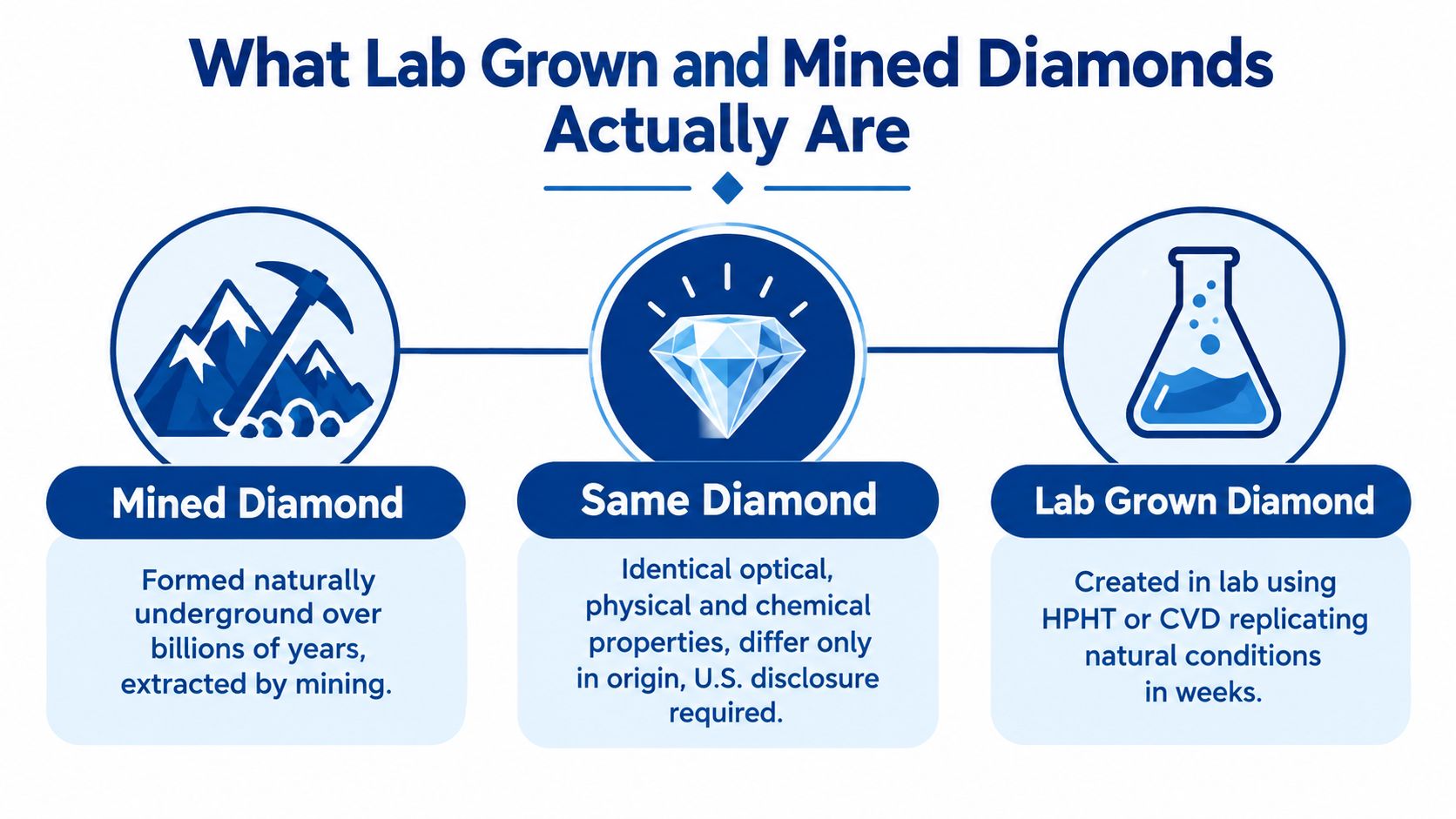
If you need a ring in hand for a Las Vegas proposal, start by identifying the center stone's origin. A mined diamond forms naturally underground and is recovered through mining. A laboratory-grown diamond is created in a controlled setting using high-pressure high-temperature, or HPHT, and chemical vapor deposition, or CVD. The source differs, but the finished material is diamond.
The FTC diamond terminology guidance explains how sellers should describe these stones in U.S. commerce. A laboratory-grown stone can be called a diamond when the laboratory qualifier appears immediately before “diamond” and is displayed with equal conspicuousness. The guidance also states that laboratory-grown and mined diamonds share the same optical, physical, and chemical properties.
“Real diamond” and “lab-grown diamond” describe different things. Real identifies diamond material rather than a simulant such as cubic zirconia or moissanite. Lab-grown identifies where the diamond was created. A properly disclosed lab-grown stone is a real diamond, but it is not a mined diamond.
How to read a Las Vegas listing
Read the origin description before judging the sparkle. A clear listing should identify whether the center stone is:
- Laboratory-grown: Created in a lab and labeled with an appropriate qualifier.
- Mined or natural: Formed naturally and recovered from the earth.
- A simulant: A different material that resembles diamond but lacks diamond's chemical structure.
A certificate or grading report describes quality factors such as cut, color, clarity, and carat. It does not change the stone's origin. An IGI report can help verify what you are buying, but it should never make a lab-grown stone sound mined.
Lab-grown diamonds now represent a meaningful part of the global diamond market, according to market-share data. In Las Vegas, that means you can reasonably ask to see certified, ready-to-view lab-grown rings beside mined options. Check the actual report, confirm the stone matches the listing, and compare the complete price before deciding.
The practical summary is simple: same diamond category, different origin and market story. For a same-day purchase, choose the option that is physically available, clearly labeled, and supported by a report you can inspect before you pay.
How They Compare on Looks Durability and Daily Wear
A proposal happening today in Las Vegas leaves little room for guesswork. Start with rings you can see and buy now, then compare cut quality, setting security, and the report. A well-cut lab-grown diamond can show the brightness, contrast, and sparkle expected from an engagement ring. A mined diamond with a weak cut can look duller, so origin alone does not determine beauty.
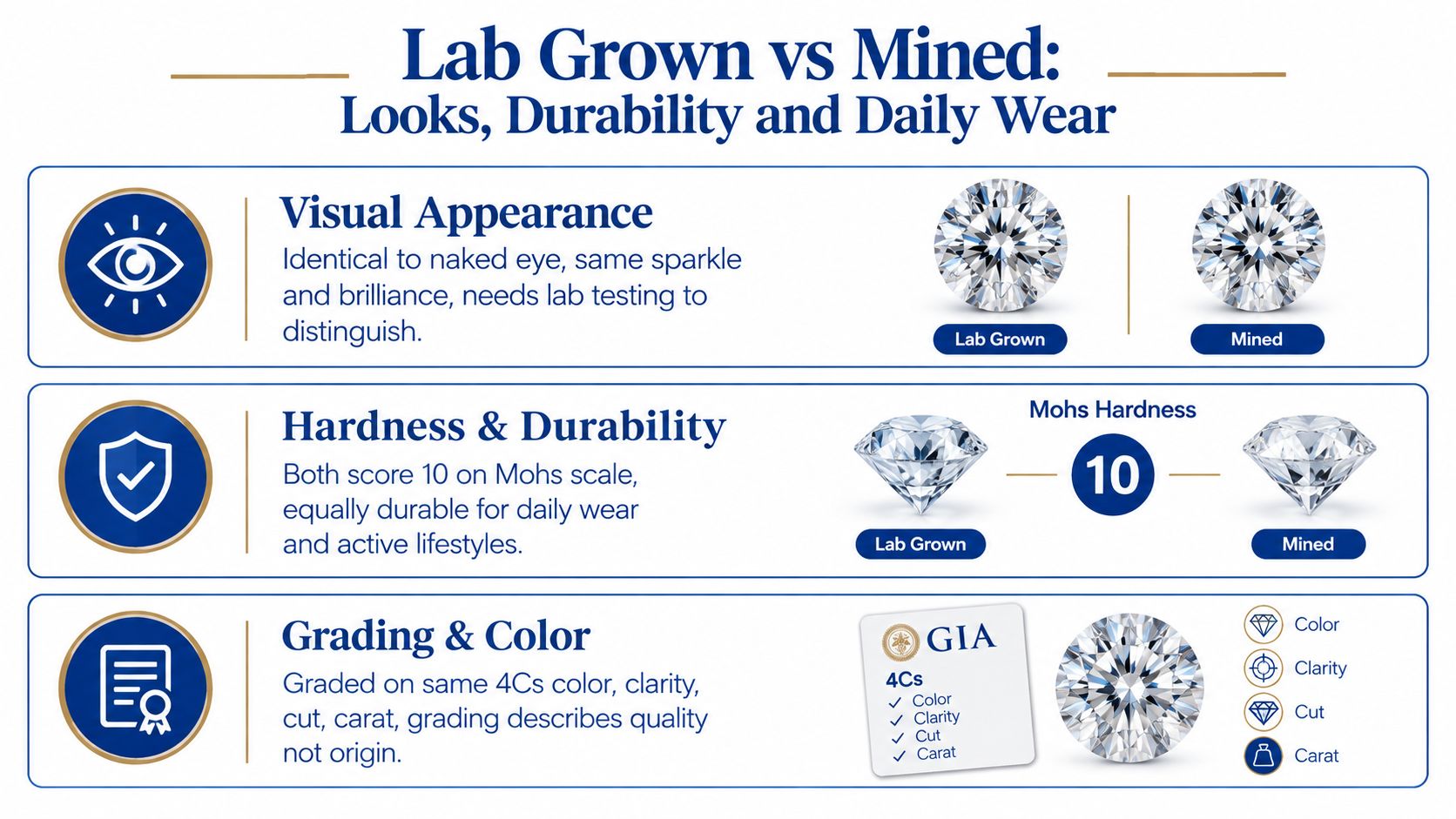
Lab-grown and mined diamonds have the same optical, physical, and chemical properties. Origin is not reliably identified by looking across a jewelry counter. Appropriate gemological testing and clear disclosure matter, especially when an in-stock ring must match its listing and report.
The visible difference is usually cut quality, proportions, clarity characteristics, color, setting, and lighting.
Both choices suit daily wear. Diamond is hard enough for ordinary routines, travel, work, and active Las Vegas lifestyles. It is not indestructible. A sharp impact can damage a stone or bend a prong, and the setting still needs routine care regardless of origin.
The quick visual matrix
| Criteria | Lab Grown Diamond Rings | Mined Diamond Rings |
|---|---|---|
| Visual appearance | Comparable sparkle and brilliance when cut and graded comparably | Comparable sparkle and brilliance when cut and graded comparably |
| Distinguishing origin | Requires suitable gemological testing | Requires suitable gemological testing |
| Daily wear | Appropriate for regular wear, with normal jewelry care | Appropriate for regular wear, with normal jewelry care |
| Quality description | Uses the familiar 4Cs, cut, color, clarity, and carat | Uses the familiar 4Cs, cut, color, clarity, and carat |
| Origin disclosure | Must be clearly identified as laboratory-grown or equivalent | Should be identified as natural or mined |
A grading report helps compare quality, but never let a grade replace your eyes. View the ring under several light sources. Check whether the center stone stays lively from the top and side. Inspect the setting for symmetry, secure prongs, and a profile that feels comfortable.
For a focused engagement-ring discussion, read whether lab-grown diamonds are good for engagement rings. If two in-stock rings have similar cut quality and grading, the wearer is unlikely to identify origin by appearance alone. Choose based on budget, origin preference, certification, and expected future value.
You can also review the visual differences in motion with the embedded comparison video below.
Cost and Value Retention in Plain Numbers
For a same-day proposal in Las Vegas, price and inventory matter more than an abstract comparison. Lab-grown rings commonly cost 50% to 80% less than comparable mined diamonds, depending on market segment and grading, according to a Bain & Company market analysis summarized for Las Vegas buyers. That difference can determine which finished, in-stock ring you can take with you today.
With the same budget, lab-grown may allow a larger center stone, higher clarity, or a more substantial setting. Mined diamonds may require a compromise in one of those areas. Compare how much visible ring your budget buys, not whether one option costs less.
Budget advantage: Lab-grown gives you more room to prioritize size, clarity, or design. Mined directs more of the purchase toward natural origin and rarity.
For a local price-and-specification guide, review what you actually get for your money with lab-grown diamonds in Las Vegas. Then compare the exact ring's availability, grading report, setting, and final price. A lower listed price has limited value if the ring is not in stock for your proposal date.
What happens after purchase
Resale is the trade-off buyers should address before paying. Independent market summaries report lab-grown resale values around 10% to 40% of original retail, while mined diamonds are commonly cited around 25% to 60%, depending on channel and grading. These ranges come from lab-grown and mined diamond resale-retention summaries. They describe market conditions, not a guaranteed offer.
A buyer keeping the ring for life may place little weight on resale. Someone who may sell, trade, or preserve liquidity should take the difference seriously. Neither ring is a guaranteed investment, and the retail price is not the amount a future buyer must offer.
| Metric | Lab-grown | Mined |
|---|---|---|
| Typical price difference versus comparable mined diamonds | 50% to 80% lower, depending on segment and grading | Baseline for the comparison |
| Reported resale retention | 10% to 40% of original retail | 25% to 60%, depending on channel and grading |
Choose lab-grown when appearance, specifications, and same-day value lead the decision. Choose mined when natural origin and stronger secondary-market expectations justify paying more now. For a sentimental lifetime purchase, focus on the ring you want to wear. If liquidity matters, include resale retention in the budget before you buy.
Certification and How to Verify an IGI Report
Certification is where rushed buyers can get into trouble. The word “certified” should lead to a specific report from a recognized grading organization, not a salesperson's description. Reports can differ in format and grading approach, so two stones with similar language may not be perfectly comparable across laboratories.
A 2025 industry discussion documented confusion around how GIA's natural-diamond grading system applies to laboratory-grown diamonds, while academic coverage has also noted that grading can vary across labs. The industry discussion and academic coverage make the buyer-protection point clear: ask which organization issued the report and what the report covers.
Four checks before you pay
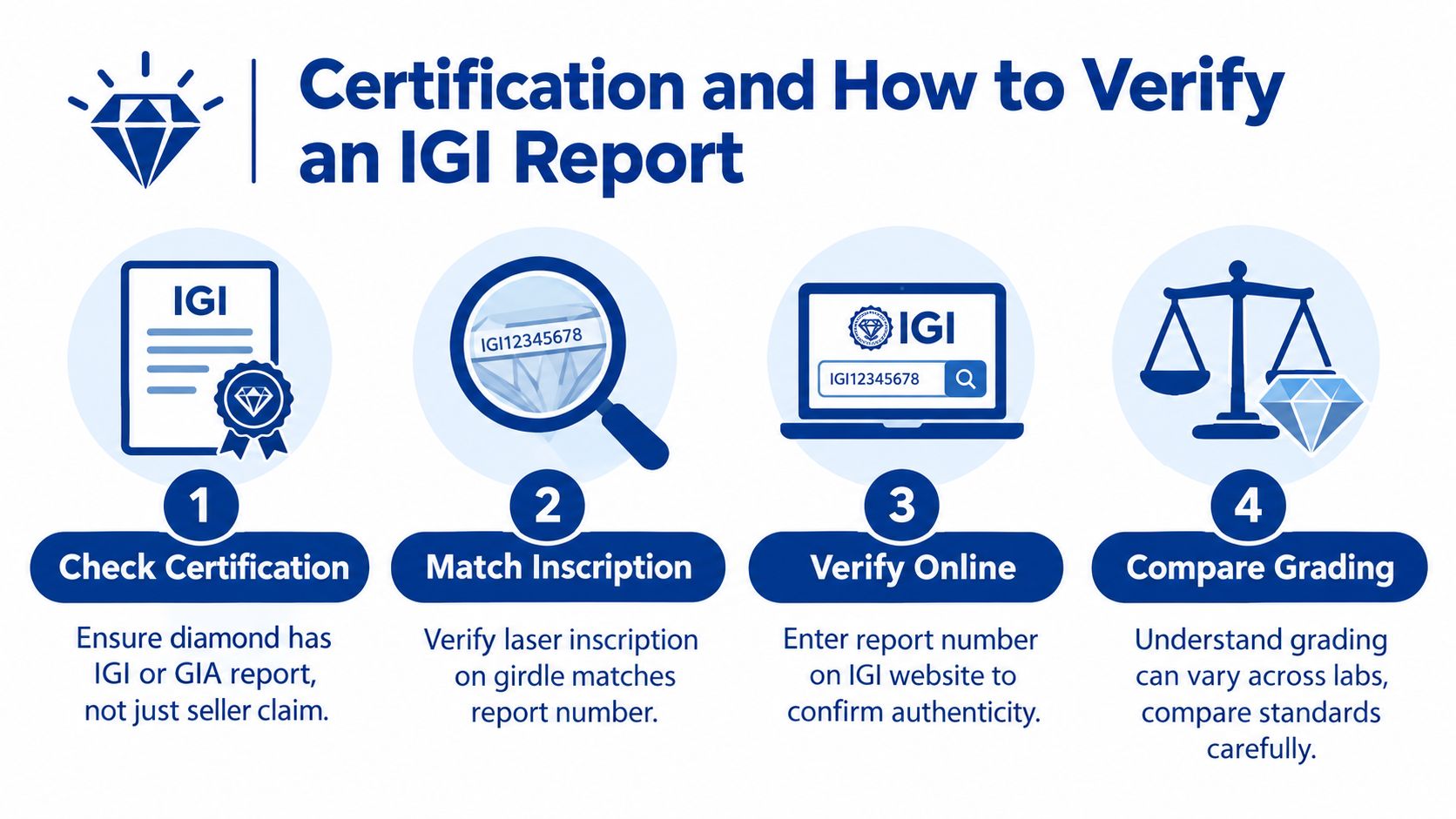
Find the report number. An IGI report has a unique identifier. Don't accept a listing that only says “IGI-certified” without showing or providing the report details.
Match the stone information. The report should correspond with the physical diamond's shape, carat, color, clarity, and cut. Diamond-report education from Yuda Crystal explains why these fields matter when comparing the document with the stone.
Verify the number online. Enter the IGI report number into the relevant verification database and compare the returned information with the physical document. The number should identify the same stone, not merely a similar one.
Check the inscription if present. A laser inscription on the diamond's girdle can provide another match point. Ask to see the inscription through suitable magnification and confirm that it corresponds with the report number.
The report reduces uncertainty, but it doesn't replace an in-person inspection. Look at the stone, review the setting, and confirm that the ring size is right for the proposal plan. Same-day buyers need a fast process, not a careless one.
Ask for three things before payment: the physical report, the report number, and a clear explanation of whether the stone is lab-grown or mined.
Which Option Fits Your Las Vegas Situation Best
If you are proposing tonight or arriving for a chapel wedding, choose the ring that is physically available, documented, and ready to leave with you. A local buyer planning months ahead can compare more settings, request a special order, and give natural origin greater weight. The right choice depends on your deadline, budget, and priorities.
Las Vegas makes same-day wedding planning practical. The Clark County Marriage License Bureau FAQ states that the bureau is open 7 days a week from 8 a.m. to midnight, including holidays, and that couples can obtain a marriage license and marry the same day. Nevada also has no waiting period or blood-test requirement for marriage licenses.

Match the diamond to your deadline
You're proposing tonight. Begin with in-stock lab-grown rings. They usually give you a clearer route to a larger-looking, certified stone without waiting for a special order. Confirm the ring size, setting condition, transparent price, and IGI report before paying.
You're marrying at a downtown chapel. Keep the appointment route short. The bureau is at 201 E. Clark Avenue, Las Vegas, NV 89101, near Fremont Street and downtown wedding venues. Schedule the ring appointment around the license and ceremony so travel does not become the day's problem.
You're working with a strict budget. Choose lab-grown when cut quality and visual size matter more than mined origin. The lower cost can leave room for a stronger setting, travel, photography, or wedding expenses. Compare complete ring prices, not only the center-stone price.
You care about natural origin. Choose mined. A lower price does not compensate for losing the feature you value most. Ask for the grading report, inspect the stone in person, and buy the origin you want.
You expect to sell later. Give mined diamonds closer consideration because their reported secondary-market retention is generally stronger. Still, ask where and how the ring could be sold, and do not assume either type will recover its retail price.
For a same-day purchase, availability outranks endless selection. Filter first by whether the ring is in town, the price is clear, and the IGI documentation matches the stone. Then make the origin decision based on what matters after the proposal, not on pressure at the counter.
Your Same Day Plan to Buy in Downtown Las Vegas
A same-day proposal starts with inventory. A ring that is not physically in Las Vegas cannot solve today's problem, and missing size, setting, price, or report details create pressure at the counter.
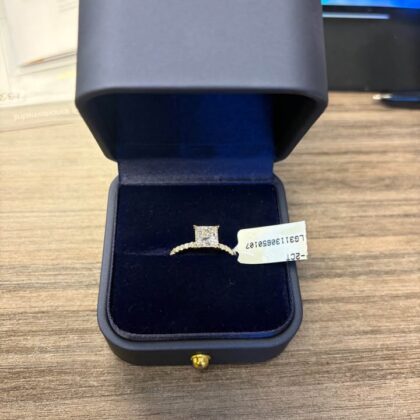
Last Call Rings LV operates by appointment at 2925 Fremont St and offers ready-to-take-home lab-grown engagement rings. Its listings identify the ring size, fixed price, setting details, and IGI report information, so you can narrow the choices before arriving. The service does not provide on-site resizing. Confirm the published size before booking.
Three steps that work under time pressure
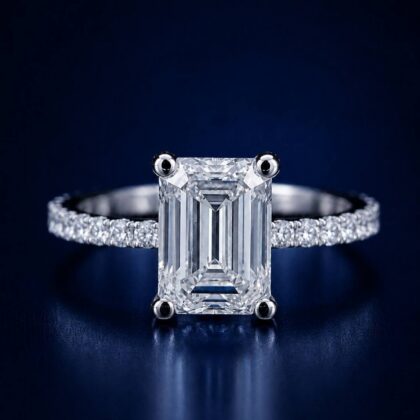
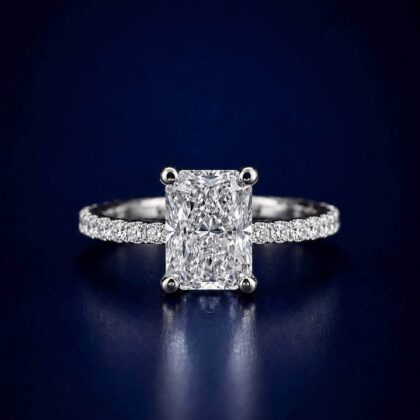
Text your budget and style. Send your spending limit, preferred metal, center-stone shape, and approximate ring size. Include whether you want an oval, emerald, radiant, pear, or another cut.
View curated in-stock options. Ask for a short group that matches your notes. At the private counter, inspect the sparkle, setting security, comfort, report details, and actual fit.
Verify, purchase, and leave with the ring. Match the IGI report number to both the listing and stone. Confirm the size, review the fixed price, and take the ring with you once every detail checks out.
For more local options, review the Las Vegas engagement ring selection. If your day includes a downtown chapel or marriage-license appointment, coordinate transportation, store timing, and the proposal location before leaving the shop. Keep the route short and protect the appointment window.
My recommendation is direct. For a same-day Las Vegas proposal, choose an in-stock lab-grown ring with clear pricing and an IGI report unless natural origin or resale expectations matter more to you. Seeing the actual ring and verifying its documentation is more useful than waiting for a perfect stone that cannot arrive today.
Text your budget, preferred style, and ring size to arrange a private viewing of physically in-stock, IGI-certified lab-grown engagement rings at Last Call Rings LV. Visit the downtown Las Vegas location, confirm the report and fit, and leave with a ring ready for your same-day proposal.